Chronic back pain can be debilitating. It affects how you move, how you sleep, and how you show up for others at work and home. Back pain sufferers often go from doctor to doctor, seeking relief through stretches, massage, NSAIDs, muscle relaxants, and injections, only for their pain to return and intensify. Failure on the part of conventional medical care to resolve chronic back pain has led many to look for alternative natural remedies that provide safe pain relief without harmful side effects.
In recent years, curcumin has gotten the attention of researchers. It is a natural anti-inflammatory compound derived from turmeric, a vibrant yellow spice derived from the rhizome (root) of the Curcuma longa plant, and a member of the ginger family. Curcumin has been used for centuries in cooking, and as a traditional medicine known for its potent antioxidant and anti-inflammatory properties.
The key question is whether curcumin can help promote inflammatory balance and reduce pain sensitivity in ways that support a long-term, integrative plan for back pain relief.
Chronic Back Pain Is Multifactorial
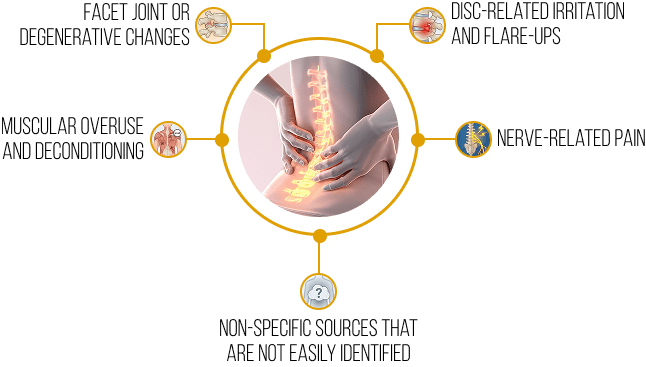
“Back pain” is a category, not a diagnosis. Chronic pain can be driven by multiple factors, including:
- Disc-related irritation and flare-ups Facet joint or degenerative changes
- Muscular overuse and deconditioning
- Nerve-related pain (radiculopathy or sciatica-like patterns)
- Non-specific sources that are not easily identified
While some attribute back pain to “wear and tear” associated with aging, many people live a long and productive life without any type of tissue degeneration. In a large systematic review of placebo-controlled trials, researchers found that only a small fraction of non-surgical, non-interventional treatments show clear benefit beyond placebo, and effects tend to be modest overall, especially in chronic low back pain. What this means is that chronic back pain can be complex, and resolving pain often requires a multi-layer approach.
The Role of Inflammation
Inflammation is not always the main cause of chronic back pain, but it can be a meaningful contributor, especially when pain is accompanied by stiffness, flareups, or nerve irritation. In addition, neuroinflammation (inflammatory signaling around nerves and spinal tissues) is gaining attention for its role in chronic pain biology. Cucumin’s anti-inflammatory properties can potentially target inflammation associated with chronic back pain.
What is Curcumin, and How are Its Actions Different from NSAIDs?
Curcumin is a bioactive compound derived from turmeric, and broadly studied for its anti-inflammatory and antioxidant effects across multiple pathways. NSAIDs mainly reduce pain by inhibiting COX enzymes that drive prostaglandin signaling. Curcumin appears to work more broadly by modulating inflammatory signaling networks and oxidative stress pathways, rather than blocking pain and inflammation via one single mechanism.

This difference matters for people looking for long-term strategies, especially if frequent NSAID use is not ideal.
Research Findings on Curcumin and Back Pain
1) Chronic low back pain: early clinical signals, limited direct trials
Direct, high-quality trials of curcumin specifically for chronic low back pain exist, but the evidence base is still smaller than for knee osteoarthritis. One recent systematic review and meta-analysis on curcumin and nano-curcumin in chronic pain reports overall pain reduction versus placebo and notes a randomized trial in chronic low back pain using a more bioavailable nano-curcumin approach.
The practical takeaway: curcumin has human data for chronic pain broadly, and there are signals for chronic low back pain, but the back-pain-specific clinical literature is not as deep yet.
2) Sciatica-like and neuropathic back pain patterns: adjunct evidence
Some back pain is less about joints and more about irritated nerves. In a clinical study evaluating an add-on formula including curcumin phytosome (with other components), participants with lumbar sciatica-related diagnoses reported meaningful reductions in neuropathic pain measures and reduced NSAID use compared with comparator arms.
This does not prove curcumin alone “treats sciatica,” but it supports a reasonable, cautious statement: curcumin-containing interventions may help support neuropathic-pain symptoms in some contexts, especially as an adjunct.
3) Mechanistic plausibility: preclinical radiculopathy data
In animal research, curcumin shows potential to reduce pain behaviors and neuroinflammatory markers in lumbar radiculopathy. However, while biologically plausible, evidence derived from animal studies does not always correlate with human outcomes.

Most Back Pain Solutions Have Limited Effects
A large placebo-controlled trial shows evidence that most interventions for chronic low back pain typically have miniscule effects, and many options have yet to be proven effective. This is why integrative planning matters. Curcumin is best viewed as a supportive micronutrient, and not a standalone solution.
Delivery Matters: Why IV or Injectable Curcumin Gets Attention
One challenge with oral curcumin is absorption and variability between formulations. This is one reason some wellness clinics explore injectable or IV curcumin as a way to increase systemic availability. The research base on injectable curcumin for chronic back pain specifically is still evolving, so claims should remain careful and grounded.

In practical wellness terms, higher-bioavailability approaches are often pursued when the goal is systemic inflammatory support, especially for people who feel stuck in recurring flare cycles.
Lifestyle Plays a Key Role
For chronic back pain, lifestyle factors largely influence the severity and duration of back pain.
Factors that promote a healthy back include:
- Strength and conditioning exercises that target the trunk and core
- Daily movement such as walking
- Consistent high-quality sleep
- Stress management strategies
- Metabolic health
- Attaining and maintaining a healthy weight
As a long-term strategy, curcumin can help support metabolic health, especially targeting chronic systemic inflammation. Curcumin should be used as a component of a larger, multifaceted strategy for combatting chronic back pain.
Curcumin Injection Therapy at Invita Wellness
At Invita Wellness, we offer physician-guided curcumin injection therapy as part of an integrative strategy for inflammation support, recovery, and longevity. Curcumin is not a cure for chronic back pain. It serves as a support tool for metabolic health that impacts systemic inflammation associated with back pain.
If you are dealing with persistent back pain and want to explore whether curcumin injections can align with your health goals, contact Invita Wellness today, and let our team guide you in developing a personalized wellness plan for addressing back pain.
Resources
Basu, Paramita, Camelia Maier, and Arpita Basu. “Effects of curcumin and its different formulations in preclinical and clinical studies of peripheral neuropathic and postoperative pain: a comprehensive review.” International Journal of Molecular Sciences 22.9 (2021): 4666. [HTML] mdpi.com
Cashin, Aidan G., et al. “Analgesic effects of non-surgical and non-interventional treatments for low back pain: a systematic review and meta-analysis of placebo-controlled randomised trials.” BMJ Evidence-Based Medicine (2025). [PDF] researchgate.net
Di Pierro, Francesco, and Roberto Settembre. “Safety and efficacy of an add-on therapy with curcumin phytosome and piperine and/or lipoic acid in subjects with a diagnosis of peripheral neuropathy treated with dexibuprofen.” Journal of pain research (2013): 497-503. [PDF] tandfonline.com
Xiao, L., et al. “Curcumin alleviates lumbar radiculopathy by reducing neuroinflammation, oxidative stress and nociceptive factors.” European cells & materials 33 (2017): 279.[PDF] nih.gov