If you’ve been feeling more tired than usual, struggling to focus, or noticing that you recover more slowly from workouts or illness, you might have come across the term NAD+. It shows up in conversations about energy, aging, and cellular health with increasing frequency. But what is it, and does it actually matter?
This guide covers the basics: what NAD+ does in the body, why levels change as we age, what the latest research actually shows, and how to think about it if you’re wondering whether it’s relevant to your situation.
What Is NAD+ and Why It Matters for Your Body
NAD+ stands for nicotinamide adenine dinucleotide. The name sounds complicated, but the concept is simple: it’s a molecule that every cell in your body uses, all day, every day. Your body produces it naturally, and it needs a steady supply to keep basic functions running properly.
Its two main jobs are helping cells produce energy and participating in repair when cells get damaged. Neither of these is optional. Without enough NAD+, cells become less efficient at both, and that inefficiency can show up in ways you actually feel.
One important thing to understand from the start: NAD+ is not a treatment, and it doesn’t cure anything. It’s a fundamental part of normal cell biology. Understanding it is useful not because it’s a magic molecule, but because it’s one of the clearer examples of how basic cellular health connects to how you feel day to day.

How NAD+ Affects Energy, Brain Function, and Recovery
Energy. Your cells don’t run directly on food. They convert nutrients into a molecule called ATP, which is what actually powers biological activity. NAD+ plays a central role in that conversion process. When NAD+ availability drops, making ATP becomes less efficient. In practice, this can show up as fatigue that doesn’t fully resolve with rest.
Brain function. The brain burns a disproportionately large amount of energy relative to its size. NAD+ is part of the metabolic process that keeps neurons fueled and functional. Some research has linked declining NAD+ levels to cognitive slowdowns associated with aging, though human evidence in this area is still early.
Metabolism. At the cellular level, NAD+ is involved in how the body processes carbohydrates and fats. This connects it to questions about metabolic efficiency and energy regulation, though the clinical significance for any individual depends on many other factors.
Recovery. When cells take damage from exercise, stress, or illness, they need to repair. NAD+ is involved in the DNA repair processes that handle this. When levels are lower than optimal, those repair processes can slow down, which may partly explain why recovery tends to become harder with age.
When NAD+ levels are insufficient, all of these processes may become less efficient. Not broken, but slower and less responsive than they could be.
How NAD+ Supports Cellular Energy Production
Inside each of your cells are structures called mitochondria. Their job is to take the nutrients you’ve absorbed from food and convert them into ATP, the fuel your body uses for almost everything it does.
NAD+ acts as a kind of shuttle in this process. It picks up electrons released during the breakdown of nutrients, carries them through a chain of reactions, and helps generate ATP at the end. Think of it as a rechargeable battery: it gets charged during digestion and discharged to power cellular activity, over and over again.

Beyond energy, NAD+ is also used by repair enzymes. A group of proteins called sirtuins use it to regulate how cells respond to stress. Another group called PARPs use it to fix DNA damage. This is why NAD+ keeps appearing in aging research. It sits right at the intersection of energy production and cellular maintenance, two things that both tend to become less efficient as we get older.
Why NAD+ Levels Decline Over Time
NAD+ levels don’t stay constant throughout life. Several things reduce them.
Age itself is the biggest factor. Research has documented a steady decline in NAD+ availability across multiple human tissues, including muscle, liver, and brain. Part of this happens because as we accumulate more DNA damage over the years, repair enzymes consume more NAD+ to address it. The supply doesn’t always keep pace with the increased demand.
Chronic stress and ongoing inflammation also drive NAD+ down. When the body is managing a sustained stress state, more repair pathways run simultaneously, drawing on available NAD+ reserves at a higher rate.
Lifestyle factors including poor sleep, low physical activity, and excessive alcohol use appear to reduce NAD+ availability as well, though the degree varies considerably from person to person.
This decline has been associated with fatigue, slower recovery, and reduced metabolic efficiency. Worth noting: these are nonspecific symptoms with many possible causes, so NAD+ is one piece of a larger picture rather than the automatic explanation.
Signs That NAD+ Levels May Be Low
There’s no single symptom that tells you definitively that NAD+ is low. The patterns that tend to correlate with declining NAD+ availability include:
- Persistent fatigue that doesn’t improve much with more sleep or rest
- Brain fog, especially difficulty concentrating or processing information that used to feel easy
- Slow recovery after physical effort or after getting sick
- A general sense that energy is harder to sustain than it used to be, even with decent habits
These symptoms overlap heavily with many other conditions: thyroid issues, poor sleep quality, iron deficiency, and a dozen other things. They’re worth paying attention to, but they’re not a diagnosis. If these patterns are consistent and unexplained by other causes, they’re worth discussing with a clinician, not just attributing to NAD+ and ordering supplements.
Who May Benefit From NAD+ Support
NAD+ support isn’t for everyone, and it’s not a first-line intervention for most people. Based on current research and clinical experience, it tends to be most commonly considered in people experiencing:
- Age-related decline in energy or mental sharpness that isn’t explained by a specific medical condition, particularly in adults over 40
- Sustained high stress, whether physical or psychological, where demand on cellular repair pathways may be chronically elevated
- Slow recovery from exercise or illness that isn’t explained by other factors
- Metabolic concerns that haven’t responded adequately to lifestyle changes alone

What NAD+ support is not: a substitute for adequate sleep, stress management, reasonable nutrition, and physical activity. Those factors directly affect NAD+ availability and cellular energy balance, and they need to be in place before supplementation or therapy makes much sense.
How NAD+ Is Evaluated in a Clinical Context
One of the most common questions people ask is whether they can simply get their NAD+ levels tested.
Tests do exist, but routine NAD+ testing isn’t standard clinical practice yet. More importantly, NAD+ concentrations vary considerably across different tissues in the body, and a blood measurement doesn’t necessarily reflect what’s happening in muscle, liver, or brain.
A number without context doesn’t tell you much.
In practice, a clinician evaluating whether NAD+ is relevant to someone’s situation will look at the full picture: symptom patterns, metabolic markers, lifestyle factors, and overall health history together. The goal isn’t just to identify that symptoms exist, but to understand why they’re there and whether NAD+ availability is actually a contributing factor rather than a coincidence. This distinction matters, because addressing NAD+ when something else is the root cause won’t produce meaningful results.
If you’re wondering whether NAD+ is relevant to your situation, the starting point is a clinical conversation rather than a lab value.

What Research Says About NAD+ and Aging
Scientific interest in NAD+ has grown substantially over the past several years. Here are three recent publications from 2025, each covering a different angle:
Zhang et al., Nature Aging, 2025. More than 25 researchers from institutions including the University of Oslo and Akershus University Hospital published a major review examining clinical and translational evidence on NAD+ supplementation across age-related conditions. The paper documents consistent associations between declining NAD+ and conditions including cognitive decline, muscle loss, and metabolic disease. Early clinical trials using NR and NMN have shown improvements in some markers. The authors emphasize that the right doses, long-term safety, and how much individual responses vary are still being established.
(Zhang et al., Nature Aging, 2025. DOI: 10.1038/s43587-025-00947-6)Vinten et al., Nature Metabolism, 2025. This review from Amsterdam UMC examined clinical evidence specifically around NAD+ precursor supplementation in human aging. The authors found that while NAD+ decline with age has been observed in some human tissues, the picture is more nuanced than animal studies suggested. Not all tissues show the same pattern, and results from clinical trials have been mixed. Their conclusion is that understanding tissue-specific effects will be essential before firm recommendations can be made.
(Vinten et al., Nature Metabolism, 2025. DOI: 10.1038/s42255-025-01387-7)Yusri et al., npj Metabolic Health and Disease, 2025. This review focused on how NAD+ metabolism connects to mitochondrial function across aging and chronic disease. It documented age-related NAD+ declines in human muscle, liver, and brain tissue running in parallel with declining mitochondrial health. The authors reviewed both preclinical and clinical evidence on NAD+ strategies and noted that while the biological rationale is well-supported, human clinical data is still developing and outcomes vary across conditions and individuals.
(Yusri et al., npj Metabolic Health and Disease, 2025. DOI: 10.1038/s44324-025-00067-0)The pattern across all three: the biology of NAD+ decline is real and well-documented. Much of the mechanistic evidence comes from preclinical studies, while human clinical evidence remains more limited and mixed. What this means for any individual, and what to do about it, is still being figured out.
NAD+ Therapy: Oral Supplements vs. IV Infusion
If you’ve started researching this topic, you’ve probably come across two main options: oral supplements and intravenous infusion.
Oral precursors (usually NR or NMN, compounds your body converts into NAD+) have been studied in multiple clinical trials and are widely available. They pass through the digestive tract and liver before reaching the bloodstream, which means a portion gets metabolized along the way. A 2026 systematic review covering 113 studies found that oral NR and NMN were generally well tolerated over weeks to months and consistently raised circulating NAD+ levels, though effects on functional and metabolic outcomes were more variable. (Ageing Res Rev . 2026 Apr:116:103057. doi: 10.1016/j.arr.2026.103057. Epub 2026 Feb 6.)
IV delivery goes directly into the bloodstream, skipping the digestive process entirely. This changes the absorption picture considerably. It’s why NAD+ IV therapy is used in clinical settings when a more direct approach is appropriate. The route matters when consistency and speed of delivery are part of the rationale. IV therapy in general is used precisely because it removes the variable of individual gastrointestinal absorption.
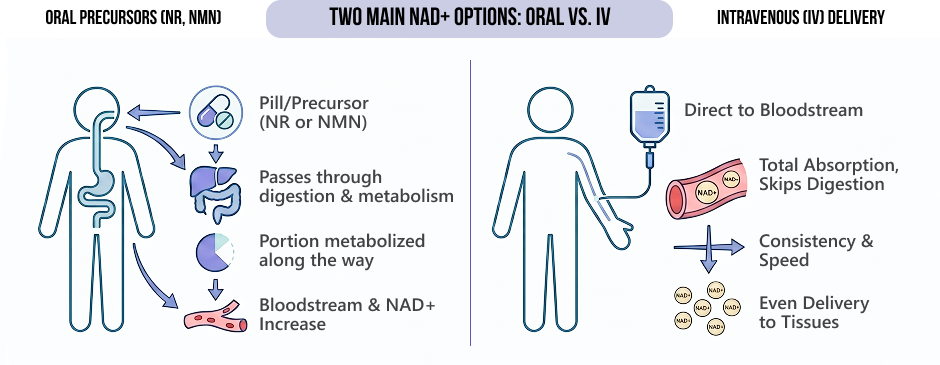
As a rough guide: oral precursors tend to be considered for general, ongoing support without acute symptoms. IV delivery tends to fit a clinical context, when a more targeted approach is warranted or when oral supplementation hasn’t produced the expected effect. Neither is appropriate for everyone, and the choice involves individual factors that require clinical evaluation.
What to Do If You Suspect Low NAD+ Levels
If what you’ve read resonates with your experience, a practical sequence looks like this:
Start with lifestyle. Sleep quality, chronic stress, alcohol intake, physical activity, and nutrition all directly affect NAD+ availability and cellular energy balance. If these aren’t being addressed, supplementation builds on a shaky foundation.
Document your symptoms clearly. Fatigue and brain fog are vague. When do they happen? How long have they been present? Are there other patterns? Clear documentation makes any clinical conversation more productive.
Consult a specialist before starting therapy. NAD+ status makes sense to evaluate alongside your overall metabolic picture, not in isolation. A clinician can determine whether NAD+ is actually a relevant factor in what you’re experiencing.
If therapy is appropriate, treat it as part of a protocol. NAD+ support tends to be most useful as one piece of a broader plan addressing your specific energy, recovery, and metabolic situation together, not as something you add on its own and wait to see results.
Is NAD+ Therapy Right for You?
The direct answer is: it depends on your individual situation, and that genuinely requires clinical evaluation to determine.
For some people, particularly those experiencing age-related energy decline or slow recovery that hasn’t responded to lifestyle changes, NAD+ support can be a meaningful part of a clinical plan. For others, the same symptoms have different underlying causes that NAD+ won’t address.
What matters is understanding your own situation before committing to any approach.
Where NAD+ Fits in a Personalized Plan
At Invita, NAD+ is one component within a broader protocol rather than a default recommendation. Whether it belongs in a given plan, and in what form, comes out of an individual assessment that looks at energy levels and fatigue patterns, metabolic function, sleep, activity, nutrition, and the person’s specific goals.
Some clients do well with a plan built around NAD+ therapy. For others, the more pressing need is cellular membrane support through Plaquex, which addresses different mechanisms. The right fit depends on what the individual actually needs, not on a default menu.

Limitations and Considerations
A few things worth knowing before drawing conclusions.
Much of the mechanistic enthusiasm around NAD+ comes from preclinical studies. Human trials exist and are growing in number, but tend to be smaller and shorter-term than what would be needed for definitive clinical recommendations.
NAD+ levels vary across tissues. What’s measurable in blood doesn’t tell the full story of what’s happening in muscle or brain tissue, which is why a single test result has limited interpretive value without clinical context.
Responses to supplementation or therapy differ between individuals. Age, genetics, baseline health, and concurrent lifestyle factors all influence outcomes, and the same protocol won’t produce the same results in everyone.
People who are pregnant, undergoing treatment for serious medical conditions, or taking prescription medications should discuss NAD+ support with their physician before starting. Existing safety reviews cover generally healthy adult populations, and data for other groups is limited.
Side effects from IV infusion, including nausea, flushing, and cramping during administration, are real and documented. They’re typically manageable through infusion rate adjustment and clinical monitoring, but they’re worth knowing about in advance.
Key Takeaways About NAD+
NAD+ is something every cell in your body depends on for energy production and cellular repair. Its levels are associated with age and lifestyle, and their decline has been linked to reduced efficiency across multiple body systems.
Symptoms like persistent fatigue, brain fog, and slow recovery can be consistent with lower NAD+ availability. They can also have many other causes, which is why clinical evaluation matters more than self-diagnosis.
Both oral precursors and IV delivery have been shown to raise NAD+ levels. Which approach makes sense depends on the individual situation. NAD+ support is most useful as part of a broader protocol assessed by a clinician, not as something added on without a clear rationale.
If this sounds relevant to what you’re experiencing, the right first step is a conversation, not a supplement order.
If you think this may be relevant to your symptoms, a clinician can help determine whether NAD+ belongs in your broader care plan. Speak with the
Invita team to discuss what a personalized assessment would look like.
discuss what a personalized assessment would look like
contact InVita Wellness today
Book Now
456 Broadway 2 Floor, New York, NY 10013, USA
Dr. Leon Shapiro
Medical Director & Protocol Specialist
Medically reviewed by Dr. Leon Shapiro, MD, Harvard-trained anesthesiologist with 25+ years in clinical and research settings. Supervises InVita's IV protocols with expertise in integrative cardiovascular and metabolic wellness.
References
Zhang J, et al. Emerging strategies, applications and challenges of targeting NAD+ in the clinic. Nature Aging. 2025.
https://doi.org/10.1038/s43587-025-00947-6
Vinten KT, et al. NAD+ precursor supplementation in human ageing: clinical evidence and challenges. Nature Metabolism. 2025.
https://doi.org/10.1038/s42255-025-01387-7
Yusri K, et al. The role of NAD+ metabolism and its modulation of mitochondria in aging and disease. npj Metabolic Health and Disease. 2025.
https://doi.org/10.1038/s44324-025-00067-0
Cory Gallagher, et al. NAD+ supplementation for anti-aging and wellness: a PRISMA-guided systematic review of preclinical and clinical evidence. Ageing Research Reviews. 2026.
https://pubmed.ncbi.nlm.nih.gov/41655607/