Short on time? Here’s what matters most:
- Peptides and steroids work through completely different mechanisms. Steroids introduce synthetic hormones that override your body’s natural systems. Peptides signal your body to produce its own hormones — a fundamentally different and generally safer approach.
- The muscle-building potential of steroids is greater — but so is the risk. Anabolic steroids produce faster, more dramatic results than peptides. They also carry documented risks of liver damage, cardiovascular disease, hormonal shutdown, and psychiatric effects that peptides do not share to the same degree.
- Peptides are not a steroid replacement — they are a different tool for a different approach. Understanding what each class can and cannot do is the foundation of any informed decision about performance enhancement.
Why This Comparison Matters More Than Most Fitness Content Admits
The question of peptides versus steroids comes up constantly in fitness communities – and almost always in a context that oversimplifies both sides.
Steroid users dismiss peptides as too slow or too mild to matter. Peptide advocates claim their compounds deliver steroid-like results without the risks. Neither position is fully accurate, and both obscure the clinical picture that anyone considering these compounds genuinely needs to understand.

Anabolic steroids and peptides are not two versions of the same thing. They are fundamentally different classes of compounds, operating through different biological mechanisms, carrying different risk profiles, and producing different outcomes across different timelines. The comparison only becomes useful when those differences are understood clearly.
This article explains both classes honestly – what they are, how they work, what the evidence supports, and how to think about which approach, if either, is appropriate for your goals.
 Important note:
 Anabolic steroids are controlled substances in most countries and are prohibited in competitive sport. Peptides occupy a complex and evolving regulatory grey area that varies by compound and jurisdiction. This article is educational in nature. It does not constitute medical advice and does not encourage the use of unregulated or controlled substances. Always consult a qualified clinician before using any performance-enhancing compound.
What Are Anabolic Steroids? A Plain-English Explanation
How Steroids Work in the Body
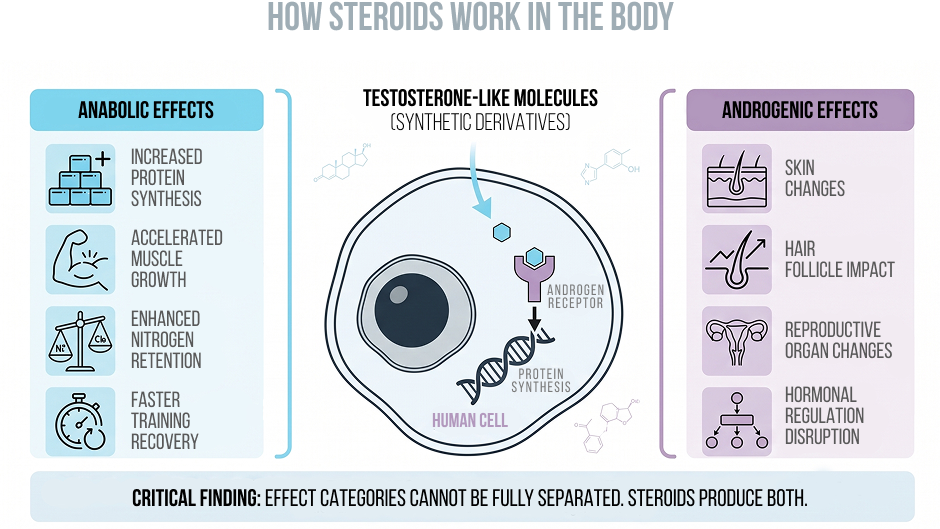
Anabolic-androgenic steroids (AAS) are synthetic derivatives of testosterone – the primary male sex hormone. When introduced into the body, they bind to androgen receptors in muscle, bone, and other tissues, producing two categories of effects:
- Anabolic effects – the ones most relevant to fitness – include increased protein synthesis, accelerated muscle growth, enhanced nitrogen retention, and faster recovery from training.
- – which become side effects in many users – include changes to the skin, hair, reproductive organs, and hormonal regulation systems.
The distinction between these two categories is important because they cannot be fully separated. Every anabolic steroid produces both types of effects to varying degrees. The ratio between them differs between compounds, which is why some steroids are considered “milder” than others – but none eliminates androgenic activity entirely.
Crucially, steroids work by introducing hormonal activity from outside the body. When synthetic androgens are present in high concentrations, the body’s own testosterone production shuts down – a process called endogenous suppression. This is not a side effect that can be avoided. It is a direct, predictable consequence of how the mechanism works.
The Most Commonly Used Anabolic Steroids
| Steroid |
Primary Use in Fitness |
Key Concerns |
| Testosterone (various esters) |
Foundation of most cycles; muscle mass, strength |
Suppression, cardiovascular effects, aromatisation to oestrogen |
| Nandrolone (Deca-Durabolin) |
Lean mass, joint support |
Severe testosterone suppression, libido effects |
| Stanozolol (Winstrol) |
Cutting, strength without bulk |
Liver toxicity, lipid disruption, joint discomfort |
| Trenbolone |
Aggressive muscle building, fat loss |
Among the harshest side effect profiles of any AAS |
| Oxandrolone (Anavar) |
Mild anabolic, often used by women |
Liver stress, suppression, lipid changes |
| Boldenone (Equipoise) |
Lean mass, appetite stimulation |
Lean mass, appetite stimulationCardiovascular strain, elevated haematocrit |
A note on Trenbolone: Trenbolone is one of the most potent anabolic compounds used in fitness contexts and carries one of the most significant side effect profiles — including severe cardiovascular strain, aggressive psychological effects, night sweats, and dramatic hormonal disruption. It is frequently discussed in fitness communities with insufficient acknowledgement of these risks.
What Are Peptides? A Plain-English Explanation
How Peptides Work in the Body
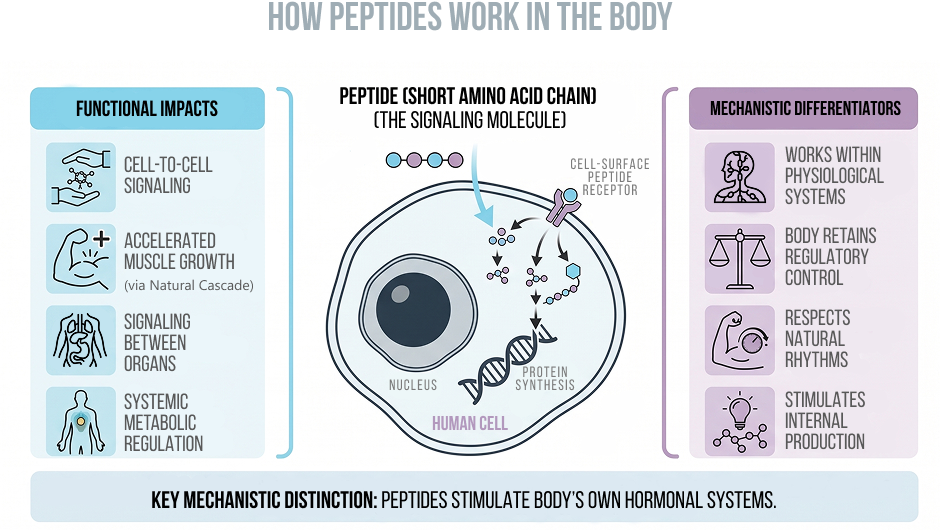
Peptides are short chains of amino acids – the same molecular building blocks that make up proteins. They occur naturally throughout the body and function primarily as signalling molecules, carrying instructions between cells, glands, and organs.
The fundamental distinction from steroids is mechanistic and clinically significant. Steroids introduce synthetic hormonal activity directly. Peptides – at least the growth-hormone-related ones most commonly used in fitness – work by stimulating the body’s own hormonal systems to produce more of a hormone naturally.
Rather than overriding the body’s regulatory systems, peptides work within them. The pituitary gland receives a signal, releases growth hormone in a pattern that broadly resembles the body’s natural rhythm, and the downstream effects follow. The body retains considerably more control over the process than it does under the influence of exogenous steroids.
This mechanistic difference is why peptides generally carry a more favourable safety profile – not because they are entirely without risk, but because they work with physiology rather than against it.
The Most Commonly Used Peptides in Fitness
| Peptide |
Mechanism |
Primary Use |
Evidence Level |
| CJC-1295 |
Stimulates GHRH (growth hormone releasing hormone) |
GH elevation, lean mass, recovery |
Better studied than many peptides; selective GH release |
| Ipamorelin |
Ghrelin mimetic – stimulates GH release |
Clean GH pulse stimulation, recovery, sleep |
Better studied than many peptides; selective GH release |
| Sermorelin |
GHRH analogue |
Anti-ageing, body composition, sleep |
Previously FDA-approved for GH deficiency; used off-label in adults |
| BPC-157 |
Growth factor upregulation, tissue healing |
Injury recovery, tendon and joint repair |
Animal studies promising; limited human trials |
| TB-500 (Thymosin Beta-4) |
Cell migration, tissue repair |
Recovery acceleration, inflammation reduction |
Primarily animal research; used clinically in horses |
| Tesamorelin |
GHRH analogue |
Visceral fat reduction, GH elevation |
FDA-approved for HIV-associated lipodystrophy |
| Semaglutide |
GLP-1 receptor agonist |
Fat loss, appetite regulation |
Robust clinical trial data; FDA-approved |
 Worth noting:
 Tesamorelin and semaglutide are peptides with full regulatory approval for specific medical indications. This demonstrates that peptides as a class are not inherently fringe — but approval for one peptide does not transfer to others. Each compound requires individual evaluation based on its own evidence base.
Peptides vs Steroids: A Direct Comparison
Mechanism of Action
| Feature |
Anabolic Steroids |
Peptides |
| How they work |
Bind directly to androgen receptors; introduce synthetic hormonal activity |
Signal the body’s own glands to produce hormones naturally |
| Hormonal impact |
Suppress natural testosterone production (inevitable) |
Generally preserve natural hormone regulation |
| Speed of effect |
Rapid – measurable changes within weeks |
Gradual – effects develop over months |
| Magnitude of muscle gain |
Significant and well-documented |
Moderate; indirect anabolic effect |
| Reversibility |
Suppression typically reversible; structural changes may not be |
Generally reversible; system retains regulatory control |
| Regulatory status |
Controlled substances in most countries |
Complex grey area; varies by compound and country |
Performance Goals: Which Delivers Better Results?
1. For maximum muscle mass gain:
Anabolic steroids produce more pronounced and faster muscle growth than any currently available peptide. This is not contested. The mechanism – direct androgen receptor activation combined with dramatically elevated anabolic hormone levels — is simply more powerful than the indirect, physiologically-regulated effects of GH-stimulating peptides.
The trade-off is a risk profile that is in a different category entirely from peptides. The question is not which produces more muscle – it is whether the magnitude of benefit justifies the magnitude of risk for the individual in question.
2. For body recomposition – losing fat while building or preserving muscle:
Both classes have a role here. GH-stimulating peptides like CJC-1295 and Ipamorelin support fat metabolism and lean mass preservation through elevated growth hormone – particularly during sleep, when GH naturally peaks. GLP-1 agonists like semaglutide have robust clinical evidence for significant fat loss.
Steroids – particularly compounds with a lower androgenic ratio – can also produce meaningful body recomposition, though the associated hormonal disruption and cardiovascular effects remain.
3. For injury recovery and tissue healing:
Peptides are meaningfully ahead here. BPC-157 and TB-500 have proposed mechanisms centred specifically on tissue repair, growth factor upregulation, and inflammation modulation. Steroids have no significant clinical evidence in this domain and some evidence that they may impair tendon and ligament integrity over time.
4. For long-term, sustainable use:
Peptides. The risk accumulation associated with long-term anabolic steroid use – cardiovascular remodelling, persistent hormonal disruption, liver stress, psychiatric effects – is well documented and progressive. GH-stimulating peptides used within physiological ranges carry a substantially lower long-term risk profile.
PERFORMANCE GOALS: STEROIDS VS PEPTIDES
The Safety Picture: What the Evidence Actually Shows
Anabolic Steroids: A Documented and Serious Risk Profile
The clinical evidence on anabolic steroid risks is extensive, consistent, and significantly more robust than most fitness content acknowledges. These are not rare or theoretical risks – they are well-characterised, predictable consequences of how these compounds work.
Cardiovascular disease. This is the most serious long-term risk of anabolic steroid use. Multiple
studies demonstrate that steroid users have significantly enlarged left ventricles, impaired cardiac function, dramatically altered lipid profiles (suppressed HDL, elevated LDL), and substantially elevated rates of cardiovascular events including heart attack and stroke. These changes appear to be cumulative and, in some cases, irreversible.
Testosterone suppression and infertility. All anabolic steroids suppress the hypothalamic-pituitary-gonadal (HPG) axis – the hormonal signalling chain that controls natural testosterone production and sperm production. Recovery after cessation varies from weeks to years, and in some
users – particularly after prolonged use – may be incomplete. Infertility is a documented consequence of long-term steroid use.
Liver toxicity. Oral anabolic steroids – particularly
17-alpha-alkylated compounds like Stanozolol and Oxandrolone – are associated with cholestatic liver injury, peliosis hepatis (blood-filled cysts in the liver), and in rare but documented cases, liver tumours. Injectable steroids carry lower but not zero hepatic risk.
Psychiatric effects. Anabolic steroids are
associated with increased aggression, mood instability, and – particularly during the post-cycle period when testosterone is suppressed – depression that can be severe. Dependence is documented and clinically recognised.
Androgenic effects. Acne, accelerated male-pattern hair loss, and – in women – virilisation (masculinising effects including voice deepening and clitoral enlargement) are androgenic effects that vary by compound but cannot be entirely eliminated.
A clear clinical reality: The fitness community frequently frames anabolic steroid risks as manageable with the right protocol, regular blood tests, and post-cycle therapy. While monitoring reduces harm, it does not eliminate it. The cardiovascular remodelling associated with long-term steroid use occurs independently of other health behaviours – and may not be fully reversible.
Peptides: A More Favourable But Not Risk-Free Profile
The safety profile of GH-stimulating peptides is considerably more favourable than anabolic steroids – but several important caveats apply.
Source quality is critical. Most peptides available for fitness use are purchased from research chemical suppliers or compounding pharmacies operating outside mainstream pharmaceutical regulation. Purity, accurate dosing, and sterility cannot be assumed. Contaminated or mislabelled peptides carry real risks that are separate from the risks of the compounds themselves.
Chronic GH elevation and insulin sensitivity. Compounds that persistently elevate
growth hormone can reduce insulin sensitivity over time – increasing the risk of insulin resistance and, with prolonged use, potentially contributing to type 2 diabetes risk. This effect is dose-dependent and most relevant with long-term, high-dose use.
Injection site risks. Most peptides are administered by subcutaneous injection. Incorrect technique, non-sterile preparation, or contaminated product carries infection risk.
Limited long-term human data. The honest position on most fitness-focused peptides – particularly BPC-157 and TB-500 – is that long-term human safety data does not exist. Animal studies are promising but cannot be directly translated to human use without assumptions that have not been clinically validated.
The Muscle Growth Question: What Can Each Actually Deliver?
This deserves a focused, honest answer – because it is the question most people are actually asking.
What Steroids Deliver for Muscle Growth
The anabolic effect of steroids on skeletal muscle is among the most well-documented phenomena in sports medicine. Controlled studies – including the landmark Bhasin et al. NEJM study – demonstrated that supraphysiological testosterone doses produced significant lean mass increases even without resistance training. With training, the effect is substantially amplified.
Typical outcomes reported in the literature include gains of 5–20kg of lean mass during a single cycle, depending on the compound, dose, duration, training, and nutrition. These are effects that cannot be replicated through any natural or peptide-based approach in the same timeframe.
The cost – hormonal suppression, cardiovascular strain, liver stress, and the psychological and physical effects of the post-cycle period – is real, significant, and accumulates with repeated use.
What Peptides Deliver for Muscle Growth
GH-stimulating peptides do not produce the direct anabolic effect of steroids. What they do is improve the hormonal environment for muscle growth – elevating growth hormone and downstream IGF-1 (insulin-like growth factor 1), which supports muscle protein synthesis, fat metabolism, and recovery.
Realistic outcomes from GH-stimulating peptide use – with consistent training and nutrition – include modest improvements in lean mass, meaningful improvements in recovery speed and sleep quality, and a gradual improvement in body composition over several months.
These are not trivial benefits. But they are different in magnitude from what steroids produce, and they occur over a longer timeline.
The honest framing: Peptides are not “mild steroids.” They are a different class of compound producing different outcomes through a different mechanism. Choosing between them is not choosing between faster and slower versions of the same result – it is choosing between fundamentally different approaches to performance enhancement, each with its own risk and benefit profile.
A Decision-Making Framework: Thinking Clearly About Your Options
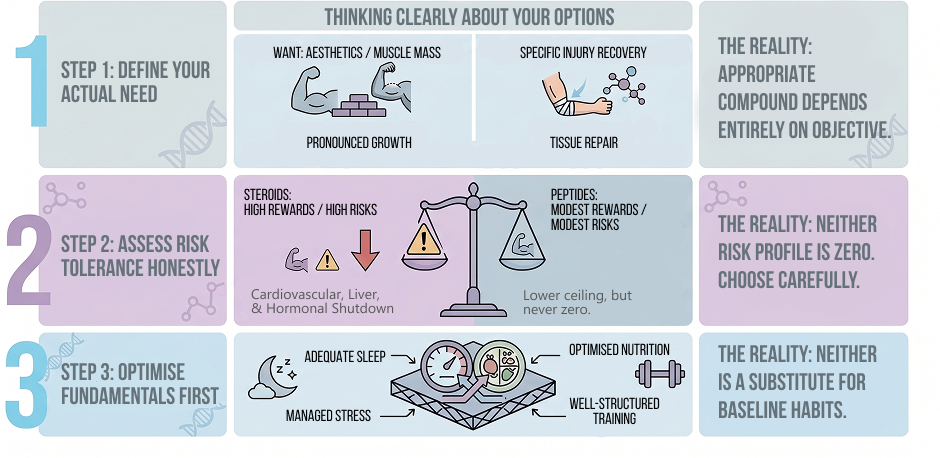
Step 1: Define what you actually need – not what you want.
There is a meaningful difference between wanting to look more muscular and needing to recover from a sports injury. Between competitive bodybuilding at an elite level and improving general fitness and body composition. The appropriate compound – if any – depends on the actual goal.
Step 2: Assess your risk tolerance honestly.
Anabolic steroids produce greater results and carry greater risks. Peptides produce more modest results and carry more modest risks. Neither risk profile is zero. If you have existing cardiovascular concerns, liver conditions, hormonal issues, fertility goals, or are subject to drug testing, steroids are a particularly poor choice. Peptides require the same honest assessment, even if the risk ceiling is lower.
Step 3: Optimise the fundamentals first.
Neither steroids nor peptides are appropriate substitutes for well-structured training, adequate sleep, optimised nutrition, and managed stress.
Book your first session at InVita Wellness, SoHo NYC
contact InVita Wellness today
Book Now
456 Broadway 2 Floor, New York, NY 10013, USA
Dr. Leon Shapiro
Medical Director & Protocol Specialist
Medically reviewed by Dr. Leon Shapiro, MD, Harvard-trained anesthesiologist with 25+ years in clinical and research settings. Supervises InVita's IV protocols with expertise in integrative cardiovascular and metabolic wellness.
Resources
Baggish AL, Weiner RB, Kanayama G, Hudson JI, Lu MT, Hoffmann U, Pope HG. Cardiovascular Toxicity of Illicit Anabolic-Androgenic Steroid Use. Circulation. 2017;135(21):1991–2002.
[PubMed] pubmed.ncbi.nlm.nih.gov
Rasmussen JJ, Selmer C, Østergren PB, Pedersen KB, Schou M, Gustafsson F, Faber J, Juul A, Kistorp C. Former Abusers of Anabolic Androgenic Steroids Exhibit Decreased Testosterone Levels and Hypogonadal Symptoms Years after Cessation: A Case-Control Study. PLoS One. 2016;11(8):e0161208.
[PubMed] pubmed.ncbi.nlm.nih.gov
LiverTox: Clinical and Research Information on Drug-Induced Liver Injury. Androgenic Steroids. Bethesda (MD): National Institute of Diabetes and Digestive and Kidney Diseases; updated 2020.
[NCBI Bookshelf] ncbi.nlm.nih.gov
Pope HG Jr, Wood RI, Rogol A, Nyberg F, Bowers L, Bhasin S. Adverse Health Consequences of Performance-Enhancing Drugs: An Endocrine Society Scientific Statement. Endocrine Reviews. 2014;35(3):341–375.
[PubMed] pubmed.ncbi.nlm.nih.gov
Hannon AM, Thompson CJ, Sherlock M. Diabetes mellitus in patients with acromegaly: pathophysiology, clinical challenges and management. Nature Reviews Endocrinology. 2024;20(8):481–495.
[PubMed] pubmed.ncbi.nlm.nih.gov
Bhasin S, Storer TW, Berman N, Callegari C, Clevenger B, Phillips J, Bunnell TJ, Tricker R, Shirazi A, Casaburi R. The Effects of Supraphysiologic Doses of Testosterone on Muscle Size and Strength in Normal Men. New England Journal of Medicine. 1996;335(1):1–7.
[NEJM] nejm.org