You’ve heard about phosphatidylcholine for your arteries, your liver, or as a part of your anti-aging program. Then you come across a fork. It is taken as a capsule by some people. Others have to sit while they’re getting it through an IV. But how does delivery make a difference, when the molecule is the same?
It does, more than most marketing admits, The pathway alters the form, speed and amount of the substance that enters the bloodstream. Both are covered in this guide, claims are limited to those supported by research and form is matched to goal.
In Simple Terms
Phosphatidylcholine is a fat which forms the membrane around each of your cells. Swallowed, it gets broken down and rebuilt before your body uses it, and most of it still gets in. Administered intravenously, it is delivered undamaged and at a concentration that is inaccessible to a capsule. For maintenance, lower intensity, oral is okay, but for vascular or anti-aging, the IV is the one that really works.
Quick Answer
- Oral and IV phosphatidylcholine are not the same tool. Oral capsules are digested and then reassembled, so the amount in the blood is not as high as an infusion, and is not the original molecule.
- Oral maintains general and liver health. If you want to take a vascular or anti-aging protocol, then you need to increase the levels of circulating phosphatidylcholine, and that’s what the IV route is designed for.
- For that goal, oral is not a cheaper version of the same thing. It’s another, less powerful one.
 This article is for education and is not medical advice. Phosphatidylcholine, in any form, is not a substitute for prescribed treatment. Talk with a qualified clinician before starting or changing therapy.
What Plaquex Is, and Why the Oral vs IV Question Comes Up
Plaquex is a brand of phosphatidylcholine, the primary phospholipid in your cell membranes. The one used in clinics is the polyunsaturated version from soy. It is used to make and repair the thin double layer that covers each cell, keeping it functional.

A particular molecule is being sold in two different ways. Phosphatidylcholine is available for purchase as a softgel (sometimes called essential phospholipids or polyenylphosphatidylcholine) or oral capsule (sometimes plaquex oral). It is also administered intravenously at clinics. The similarity in the label leads to the assumption that the result is similar. They are not handled the same as the first minute
How Your Body Absorbs Oral Phosphatidylcholine
This is the one thing that people don’t expect: oral phosphatidylcholine is well absorbed. In human tracer studies, over 90% of the oral polyenylphosphatidylcholine is absorbed from the intestine. So, the concept that capsules do nothing is incorrect. Though don’t take 90% to mean that the oral is an IV. Absorbed and delivered are not synonymous and the next part explains why.
The trick is in the process. Phosphatidylcholine does not get absorbed intact. It is broken down by enzymes in the gut into lysophosphatidylcholine and a fatty acid. You then re-synthesize it and transport it out of the intestine on lipoproteins via the lymphatic system. Once it enters the bloodstream, it is digested and reassembled again and what you find in your plasma is not the same as what you ate.
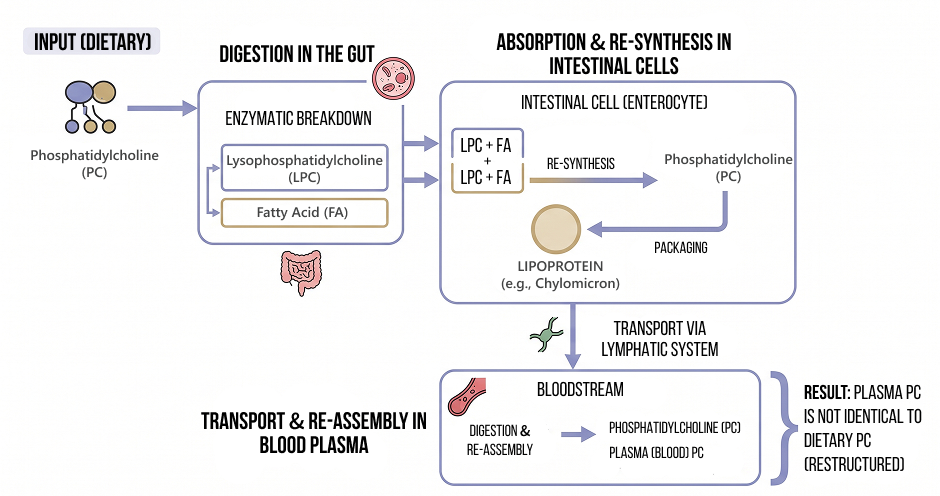
There are two practical implications of this. First, oral works are not performed on a sharp curve but in a gradual manner. Second, your digestion and the food you eat will influence how much, and in what form, you end up with. A third thing that is most important for vascular objectives: a capsule can’t push your circulating phosphatidylcholine to the level that an infusion can. It’s not the number of capsules you take, it’s your digestion that sets the limit.
Key Takeaway
- Oral phosphatidylcholine enters the body (more than 90%) but is metabolized and reassembled before reaching the blood.
- Easy and gradual, and suitable for a small addition. It can’t access circulating PC at infusion level.
How IV Plaquex Reaches Your Cells Differently
An IV bypasses the digestive system. The infusion directly delivers intact phosphatidylcholine into your bloodstream, which then can be incorporated into your lipoproteins and transported to tissues without digestion in the gut. This means that a capsule can’t cause the same amount of phosphatidylcholine to circulate in the bloodstream in one sitting.
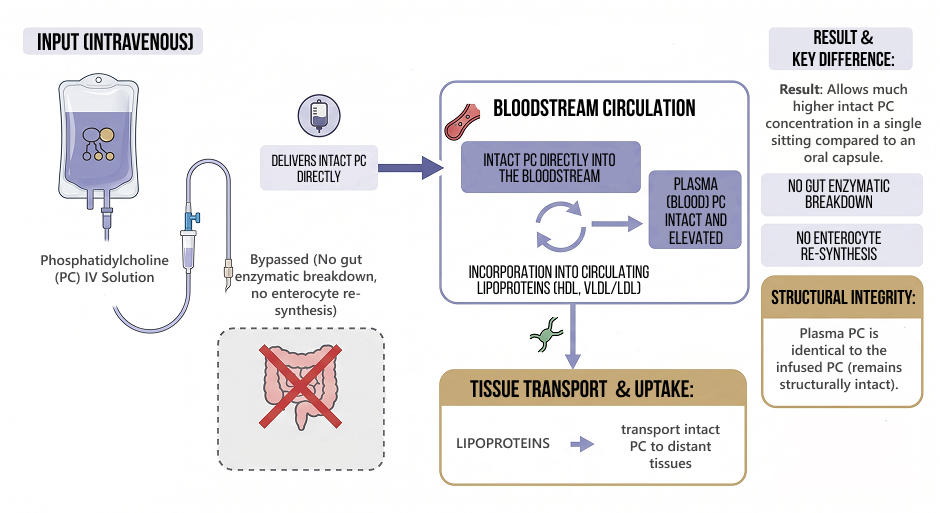
This direct delivery is the reason that clinics use the IV route for goals other than liver support. The vascular and anti-aging protocols are based on the mechanistic action of increasing circulating phosphatidylcholine, which results in the increase HDL-type particles that facilitate the movement of cholesterol.
There are trade-offs, too. The IV is invasive, will take 60-90 minutes, will occur in a clinic, and should be supervised. It’s a protocol, not a habit. But that’s also why a capsule is not the answer here: the vascular and anti-aging benefits come from achieving a circulating level, and the reshaping of lipoproteins, and oral delivery just can’t do that.
Oral vs IV Phosphatidylcholine at a Glance
| Factor |
Oral |
IV (Plaquex) |
| How it gets in |
Digested, rebuilt, enters via lymph |
Delivered intact, straight into blood |
| Absorption |
Over 90%, but transformed on the way |
Bypasses digestion; immediate rise |
| Onset |
Gradual, steady |
Fast, higher peak |
| Best-evidenced use |
Liver support (enzymes, fat) |
Vascular, anti-aging, detox protocols |
| Setting |
At home, daily |
In clinic, supervised series |
| Evidence strength |
Moderate, but only in liver; not in major guidelines |
Mechanism plausible; human trials limited |
| For vascular / anti-aging goal |
Little evidence; cannot reach needed levels |
The route this goal actually depends on |
Key Differences at a Glance
- Oral is easy and incremental. IV is direct and immediate.
- Oral is the most well supported from humans in liver support. IV is for vascular and anti-aging purposes.
- Both are not approved by the FDA for cardiovascular or liver disease.
Which Form Is More Effective? It Depends on Your Goal
Effectiveness is not a one-size-fits-all number. This is relative to the task you are attempting.
For liver support
Oral has the most direct evidence here. The results of a network meta-analysis of essential-phospholipid trials revealed significant decreases in liver enzyme ALT, and a more recent phase 4 randomized trial evaluated oral essential phospholipids in fatty liver disease. Though let’s be honest: a Cochrane review notes much of this information is regional and the big liver guidelines (AASLD, EASL) don’t yet recommend phospholipids as a treatment.
For vascular and anti-aging purposes
This is where IV is used, and where one should set expectations. The mechanism is plausible and human signals are available for better lipid handling and HDL-type particles. Yet there are very few randomized, controlled, large, modern studies that show that IV phosphatidylcholine removes arterial plaque in humans, and many of the studies were conducted in the past or were not randomized. The honest framing is: plausible mechanism, encouraging early data, not settled proof.
This is the part that counts in the selection process. This is not a goal that can be saved by oral. It is most strongly supported in the liver, not the arteries, and cannot be raised to the circulating levels needed by the vascular rationale. For vascular or anti-aging purposes, neither of the two forms has been proven, and the IV form is the only way to get the mechanism in the first place.
Oral is not the less dangerous and less expensive option of this. This is the non-reaching version for this goal.
How to Choose Between Oral and IV
A simple way to think about it:
1. Goal is consistent, liver-centric maintenance within a budget: oral is reasonable, and that’s where the evidence is best.
2. Goal is a vascular, detox or anti-aging protocol: the IV route is the one that actually delivers it. A capsule cannot achieve those levels, otherwise oral wouldn’t be a less expensive option, it would be a different and less potent one.
3. If you can’t tolerate or absorb it orally or you want a defined, supervised course: IV suits you better.
The majority of patients who arrive at us are in the second category (vascular, detox, anti-aging) and in this instance, the IV is an effective method of treatment not a more costly approach to the same treatment that a capsule provides. We chart this out with you, screen for the cautions below, and develop the course around your goals. If this sounds like you, you can book Plaquex IV therapy in NYC and discuss your plan with the clinical team. See our Plaquex research and reviews for the underlying studies.
What Phosphatidylcholine Cannot Do
By setting expectations, you avoid disappointment and overpaying for something that it is not able to provide.
- It has not been proven to be a standalone remedy for atherosclerosis or heart disease, either alone or in combination.
- It is not a substitute for statins, blood-pressure medications, or other medications that are prescribed for cardiovascular care.
- It will do nothing to compensate for a poor diet, smoking or lack of activity. It is in addition to those basics and not instead of them.
- It’s not approved by the FDA to treat cardiovascular or liver conditions, so it should be presented as a supportive rather than a cure.
Risks, Side Effects, and Who Should Not Use It
Both types are usually safe to take. Most side effects are mild.
- Oral: diarrhea, slight nausea or stomach upset, particularly at higher doses.
- IV: vein warmth/irritation, lightheadedness if infused too quickly, and occasional loose stools. Early in a course, an increase in LDL or liver enzymes may occur and often resolve.
Who should not use it or be cleared first. Safety information is not available for people who are pregnant or breastfeeding, unstable heart disease, or people who have untreated arrhythmias, or blood thinners should not begin without medical clearance. This should be addressed during intake and screening prior to infusion.
When to seek medical attention. Stop and get help right away if you notice hives, swelling of the lips or throat, trouble breathing, chest pain, a fast or irregular heartbeat, or fainting during or after an infusion. These can signal an allergic or cardiovascular reaction and need prompt care
Frequently Asked Questions
Is there any evidence that oral plaquex works or is the IV the only viable choice?
Oral works well for one thing, liver care, with more than 90% absorption and with strong human evidence. It has much less evidence for a vascular or anti-aging use, however, and cannot attain the circulating level that is necessary for that use. For that, the IV is the one that delivers, not the more expensive one.
Why would I pay for an IV when it’s absorbed by a capsule and more than 90%?
If absorbed, it is not delivered. The capsule is digested and rebuilt before the molecule can get to your blood and no matter how many capsules you take, they never reach the amount of the infusion. Liver maintenance is fine. That’s the whole point of a vascular or anti-aging protocol, and only the IV can do that.
Is it OK to use oral phosphatidylcholine between IV’s?
It is not the protocol and is not used as light maintenance by some people. If you prefer support between sessions, we will be able to guide you on what will work for you, and not as an IV.
What are the side effects?
Minor (usually oral, sometimes IV) or stomach upset with loose stools or short dizziness with vein warmth. If it’s more, like an allergic reaction, it’s rare but should be addressed right away.
Considering the IV Route?
If you are looking for a supervised vascular, detox or anti-aging protocol that requires direct delivery, then that is what the IV form is for. Your history is reviewed, contraindications above are screened for, and a course is designed based on your goals and not a recipe. Book a Plaquex IV consultation in SoHo to determine if oral, IV or both is right for you.
Book a Plaquex IV consultation in SoHo NYC
contact InVita Wellness today
Book Now
456 Broadway 2 Floor, New York, NY 10013, USA
Resources
Intestinal absorption of polyenephosphatidylcholine in man. PubMed (PMID 7175371).
Link
Phosphatidylcholine hydrolysis and lymphatic absorption of phospholipids. PubMed (PMID 11238749).
Link
Dajani AI, Popovic B. Essential phospholipids for NAFLD with metabolic syndrome: systematic review and network meta-analysis. World J Clin Cases, 2020. PMC7674728.
Link
Stefan N, et al. Effect of Essential Phospholipids in MASLD: a randomised phase 4 trial (EXCEL). Liver International, 2026. doi:10.1111/liv.70601.
Link
Essential phospholipids for people with non-alcoholic fatty liver disease (review). PMC6447141.
Link
Acute effects of IV apoA1/phosphatidylcholine discs on plasma lipoproteins in humans. Arterioscler Thromb Vasc Biol, 1999.
Link