Reviewed by the InVita Wellness Clinical Team InVita Wellness, SoHo, New York City
Both come up in the same conversations. Men’s health clinics, training forums, longevity podcasts. Both get attached to the same list of hopes, meaning more energy, better body composition, faster recovery, stronger libido.
That overlap in promised outcomes is why so many men treat the two as interchangeable, or assume peptides are simply the newer version. They are not. They act on different biological systems, serve different clinical purposes, and sit at very different levels of evidence.
Choosing between them without a diagnosis is the most common mistake in this area. The useful question is not which is better. It is what is actually causing the symptoms, and that is answered by bloodwork rather than by an article. What follows sets out how each one works, what the trials actually found, and which findings point where. If you are researching peptide therapy as an alternative to testosterone, the short version is that it is not one.
Quick Answer
- Peptides and TRT are not alternatives to each other. TRT introduces testosterone from outside the body to restore levels in men who have clinically confirmed testosterone deficiency.
- FDA-approved testosterone products are available for specific forms of hypogonadism, with substantial clinical trial and long-term clinical experience behind them.
- Peptides are signaling molecules that prompt the body’s own production, most commonly on the growth hormone axis rather than the testosterone axis. That distinction is the whole point.
- Growth-hormone-axis peptides such as sermorelin, CJC-1295 and ipamorelin do not function as testosterone replacement and should not be used as substitutes for TRT in confirmed testosterone deficiency.
- The two can be used alongside each other where two separate deficiencies have been documented. Which applies to you is decided by labs.
Medical Disclaimer
This article is intended for educational purposes only and does not constitute medical advice, diagnosis, or treatment recommendations. Individual health decisions should always be made in consultation with a qualified, licensed physician. Testosterone replacement therapy and peptide therapies carry real physiological risks and require proper medical supervision and ongoing monitoring. Do not start, stop, or modify any treatment based solely on information contained in this article.
The Question That Actually Matters
Symptoms point toward a conversation. Labs identify a cause. The cause determines which treatment, if any, is appropriate. In that order.
A man who is exhausted, has lost muscle and has no interest in sex might have clinically low testosterone. He might have normal testosterone and a decline in growth hormone pulsatility, meaning how strongly and how often growth hormone is released during deep sleep. He might have both. He might have neither, and the answer might be sleep apnea or thyroid disease.
Clinical pearl
Symptoms are a starting point, not a diagnosis. Two men with identical complaints can have completely different underlying causes. Labs are what separate guesswork from precision, and they are also what tells you whether either of the treatments described here is relevant at all.
How Testosterone Works
Testosterone is the primary male sex hormone, regulated by the hypothalamic pituitary gonadal axis, a feedback loop between brain and testes that controls how much the body produces. It influences muscle mass, bone density, mood, libido, red blood cell production and cognition.
Testosterone levels may decline gradually with age, although the degree varies considerably and is strongly influenced by overall health, obesity and comorbidity. The European Male Ageing Study attributed much of that apparent age effect not to chronological age but to accumulated comorbidity, obesity in particular, suppressing LH secretion. Which is another way of saying a birth year predicts very little and a lab panel predicts a lot.
When consistently low testosterone occurs alongside symptoms affecting quality of life, the diagnosis is hypogonadism. Both halves are required. A number on its own is not a diagnosis, and neither are symptoms on their own.
How Peptides Work
Peptides are short chains of amino acids that act as biological signals. Rather than replacing a hormone, most therapeutic peptides prompt the body to produce or release its own, to repair tissue, or to regulate a process.
They work through the body’s existing regulatory systems. TRT works around them. That is the fundamental difference, and almost everything else follows from it.
What TRT Is
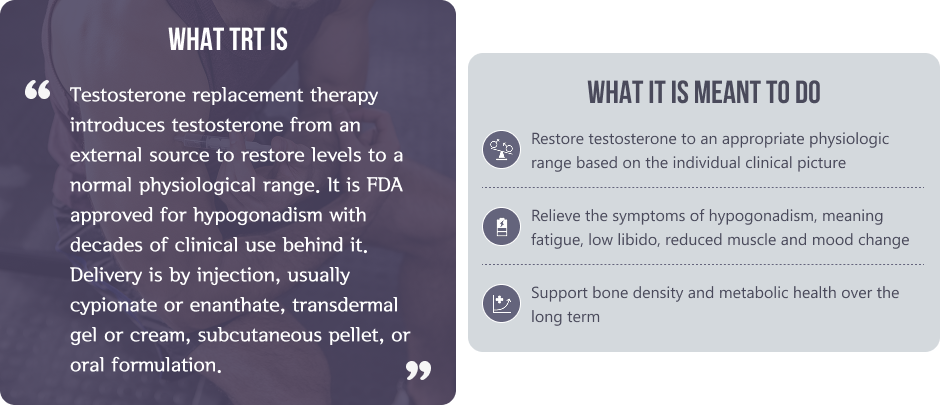
Testosterone replacement therapy introduces testosterone from an external source to restore levels to a normal physiological range. It is FDA approved for hypogonadism with decades of clinical use behind it. Delivery is by injection, usually cypionate or enanthate, transdermal gel or cream, subcutaneous pellet, or oral formulation. Testosterone therapy often involves long-term treatment with ongoing reassessment and monitoring.
What it is meant to do
- Restore testosterone to an appropriate physiologic range based on the individual clinical picture
- Relieve the symptoms of hypogonadism, meaning fatigue, low libido, reduced muscle and mood change
- Support bone density and metabolic health over the long term
Important considerations with TRT
- It suppresses your own testosterone production through the same feedback axis it acts on
- It reduces sperm production, which matters a great deal if you intend to conceive
- It requires ongoing clinical and laboratory monitoring, which may include hematocrit, PSA where appropriate, blood pressure and other cardiovascular risk factors
- It is not appropriate with active prostate cancer, untreated severe sleep apnea, or certain cardiovascular risk profiles
What Peptide Therapy Is
Peptide therapy uses specific amino acid sequences to influence biological processes. In men’s health the relevant ones act on growth hormone release, tissue repair, or sexual function through the central nervous system. Peptide injection therapy is typically subcutaneous and typically self-administered between clinic visits.
The single most important line in this article
The growth-hormone-axis peptides discussed here do not replace testosterone. A man with confirmed testosterone deficiency should not substitute GH-axis peptide therapy for appropriately indicated testosterone treatment. These are different problems on different axes, and growth hormone stimulation does not correct a testosterone deficiency.
Peptide
Mechanism
Commonly discussed or researched application
Sermorelin
GHRH analog, stimulates pituitary GH release
GH support, body composition, sleep
CJC-1295
Modified GHRH analog, longer acting
Fat metabolism, recovery
Ipamorelin
Selective GH secretagogue, GH release without cortisol elevation
Growth-hormone secretagogue; human outcome and safety data remain limited
BPC-157
Body protection compound, tissue repair and anti-inflammatory
Investigational tissue-repair and gastrointestinal applications; evidence is predominantly preclinical
PT-141
Melanocortin receptor agonist acting centrally
Sexual function
On terminology. A GHRH analog mimics growth hormone releasing hormone. A GH secretagogue triggers growth hormone secretion through a separate receptor. IGF-1 is the downstream marker used to assess whether the growth hormone axis is responding, because growth hormone itself is too pulsatile to read from a single draw.
Peptides vs TRT, Side by Side

Mechanism
Replaces testosterone directly
Stimulates the body’s own hormones or repair systems

Primary target
Androgen receptors
Pituitary, GH axis, tissue receptors

Clinical goal
Restore testosterone levels
Support GH axis, recovery, body composition

Best candidate
Confirmed low testosterone
Normal testosterone with suboptimal GH or recovery

Key advantage
Fast, predictable, well studied
Leaves the natural regulatory axis intact

Key limitation
Suppresses own production, affects fertility
Evidence varies widely, most compounds not FDA approved

Evidence level
Strong, multiple large RCTs
From FDA approved down to preclinical only

Regulatory status
FDA-approved testosterone products exist for specified indications; product labeling applies
Mixed, differs by compound
What the Evidence Actually Says
TRT, well established
The Testosterone Trials, a coordinated set of placebo-controlled studies across twelve US academic medical centers, were published by Snyder and colleagues in 2016. Sexual function improved significantly against placebo. Worth being precise about the rest, because it is often reported loosely. Walking distance and vitality did not meet their endpoints in that paper, and the bone density finding comes from a separate publication a year later rather than from the trial usually cited for it.
On cardiovascular safety, the TRAVERSE trial randomized men with hypogonadism and existing or high cardiovascular risk. Testosterone was non-inferior to placebo for major adverse cardiac events, which was genuinely reassuring and was the headline.
The part of TRAVERSE that gets left out
The same trial reported a higher incidence of pulmonary embolism, atrial fibrillation, non-fatal arrhythmia and acute kidney injury in the testosterone arm. Non-inferior on cardiac events is not the same as no signal anywhere. If you are considering TRT and someone quotes TRAVERSE at you as an all-clear, ask them about these, and about blood pressure, which now carries its own class-wide warning.
The same trial reported a higher incidence of pulmonary embolism, atrial fibrillation, non-fatal arrhythmia and acute kidney injury in the testosterone arm. Non-inferior on cardiac events is not the same as no signal anywhere. If you are considering TRT and someone quotes TRAVERSE at you as an all-clear, ask them about these, and about blood pressure, which now carries its own class-wide warning.
Sermorelin, off label with supportive human data
Sermorelin was previously approved for use in children for growth hormone deficiency, but not for commercial reasons; hence, the FDA formally noted that it was not approved for commercial use, which is why it is still available for compounding. Corpas and colleagues in 1992 administered twice-daily GHRH(1-29) to ten older men and compared them to nine younger men, and they found an age-related decrease in growth hormone and IGF-1 that was reversed by GHRH(1-29). Hormone levels were used as endpoints. Small sample size and body composition was measured but did not demonstrate improvement.
Closer to this article’s question, Sigalos and colleagues in 2017 measured IGF-1 response to growth hormone secretagogue treatment in hypogonadal men specifically, and found it rose. This is an indication that the axis is reacting. It doesn’t say that the men were happier, which is a different endpoint and harder.
Sermorelin is not approved for use in adults for hormone optimization. Compounding pharmacies are available for adult use.
CJC-1295 and ipamorelin, mechanism without outcomes
In 2006, Ionescu and Frohman demonstrated that pulsatile growth hormone secretion remains during continuous stimulation with GHRH. Raun and colleagues in 1998 have characterized the selectivity of Ipamorelin in swine and rat models, not in humans, as growth hormone release without any appreciable elevation of cortisol, ACTH or prolactin. There are no large randomized human trials for either of the compounds.
Both are not approved by the FDA for any indication. In 2024, both compounds were considered by the FDA’s Pharmacy Compounding Advisory Committee and recommended to not be listed on the respective 503A bulk substances list. They should be considered under the current FDA requirements as both regulated and compounded.
BPC-157, investigational
Preclinical studies refer to wound healing and gastroprotective studies in animal models. A 2025 systematic review screened 544 articles and included 36, of which 35 were preclinical and one was clinical. Should not be described as a clinically established treatment in humans.
PT-141, approved for a different population
Bremelanotide is FDA approved for the treatment of hypoactive sexual desire disorder for premenopausal women, as part of the RECONNECT phase III trials. It is clearly labelled as not recommended for men. Off label use in males, contraindicated in uncontrolled hypertension and known cardiovascular disease, and transient blood pressure rise after each dose.
Can They Be Used Together
Yes, in some situations. A man with confirmed low testosterone may be on TRT while using peptide support for recovery, sleep or body composition through the growth hormone axis. These are parallel pathways rather than competing ones, and treating one does not address the other.
The qualifier matters more than the answer. Combination protocols are not a case of more being better. Combination treatment may be considered when separate clinical findings provide a rationale for addressing both pathways. Stacking without a diagnostic rationale adds cost and risk without adding benefit.
Who May Be a Candidate
TRT may be appropriate for men who
- Have low testosterone confirmed on repeated laboratory testing, typically two separate morning draws
- Have symptoms of hypogonadism alongside those numbers, meaning fatigue, low libido, reduced muscle or mood change
- Have been evaluated for secondary causes such as sleep apnea, obesity or metabolic dysfunction first
Peptide therapy may be worth discussing for men who
- Have normal or borderline testosterone but poor recovery, disrupted sleep or stalled body composition
- Are looking at injury recovery, or sexual dysfunction that is not driven by low testosterone
- Have undergone appropriate evaluation of the growth hormone axis, including IGF-1 where clinically relevant
When Is TRT Clinically Indicated?
Confirmed Lab Deficit
Low testosterone verified across at least two separate morning blood draws.
Matching Symptom Profile
Clear hypogonadal symptoms present, such as chronic fatigue, reduced muscle mass, low libido, or mood changes.
Root-Cause Evaluation
Prior screening to rule out or address secondary factors like sleep apnea, obesity, or metabolic dysfunction.
When to Consider Peptide Therapy
Optimized Baseline
Normal or borderline testosterone paired with persistent issues like poor recovery, disrupted sleep, or stalled body composition.
Non-Hormonal Targets
Specific goals like injury recovery or sexual dysfunction that are not driven by underlying low testosterone.
Axis Pre-Screening
Prior clinical evaluation of the growth hormone axis, including IGF-1 testing where appropriate.
Who Is Not a Candidate
TRT is generally not appropriate for men who have any of the following.
- Active or suspected prostate cancer
- Plans to conceive in the near term, given the effect on sperm production
- Untreated severe sleep apnea, or cardiovascular risk that has not been addressed
- Elevated hematocrit that has not been investigated
For peptides, the picture differs by compound. Growth hormone stimulating compounds require careful review with active malignancy or a history of hormone sensitive cancer. In tested sport, the position also differs by compound, so check your own before assuming.
- Testosterone falls under WADA category S1, anabolic agents
- Sermorelin, CJC-1295, ipamorelin and tesamorelin fall under category S2.2, growth hormone and its releasing factors
- BPC-157 is not named on the 2026 List and is caught by category S0, non-approved substances
- All of the above are prohibited at all times, in and out of competition, under the 2026 List. Confirm current status with your own anti-doping authority before starting anything
See a physician promptly rather than booking a wellness consultation
Chest pain or breathlessness on exertion, swelling or pain in one leg, sudden severe headache or visual change, blood in urine or semen, a testicular lump, or fatigue that arrived over days rather than years. Some of these overlap with the risks discussed above and some point somewhere else entirely. None of them is a question for a hormone panel first.
What Neither Can Do
- Neither corrects a problem that has not been identified. Both are treatments for specific findings, not general performance upgrades
- Peptides cannot raise testosterone, and TRT cannot restore growth hormone pulsatility
- Neither substitutes for sleep, resistance training or bodyweight management, and untreated sleep apnea in particular will undermine both
- Neither is a short course. TRT often becomes long-term therapy and suppresses endogenous testosterone production while treatment continues. Peptide effects fade when the protocol stops
- Neither delivers a predictable timeline. Anyone quoting a specific outcome by a specific week is describing marketing rather than physiology
WHAT NEITHER CAN DO
No Unidentified Fixes
Both are targeted treatments for specific findings, not general performance upgrades
Strict Biological Boundaries
Peptides cannot raise testosterone; TRT cannot restore growth hormone pulsatility.
Not a Lifestyle Substitute
Neither substitutes for sleep, resistance training, or nutrition. Untreated sleep apnea undermines both.
No Short-Course Magic
TRT is often long-term (suppresses endogenous T); peptide effects fade after protocol stops.
Unpredictable Timelines
No guaranteed weekly timeline exists – that is marketing, not physiology.
Questions to Ask Your Physician
- Do my lab results support this treatment, or are we treating symptoms alone?
- What is the root cause of my symptoms based on my bloodwork?
- What is the regulatory status of this specific compound, approved, off label, or investigational?
- What monitoring is required, and how often, and for how long?
- What are the realistic risks given my personal and family history?
- If I start TRT, what happens to my own production, and what happens if I stop?
- How does this affect fertility if I am of reproductive age, and what are the alternatives if that matters to me?
- What lifestyle factors should be addressed first or alongside?
How Evaluation Works at InVita
No protocol is recommended before there is a clear diagnostic picture. That is the whole basis of the approach and it is why the first appointment does not end with a prescription.
Sequence
- Initial consultation covering symptoms, health history, lifestyle and goals
- Diagnostic workup including total and free testosterone, LH, FSH, estradiol, SHBG, IGF-1, thyroid panel, metabolic panel, CBC and PSA
- An individualized protocol built from the findings and the clinical presentation, with no standard packages
- Ongoing monitoring through repeat labs and follow-up review
- Lifestyle integration, meaning nutrition, sleep and exercise treated as part of the plan rather than as an afterthought
Men may be coming in with the expectation that they are going to find that the solution is going to be testosterone, but when they get to the laboratory they’re going to find out that’s not the case. The symptoms can be caused by a variety of factors, including, but not limited to, testosterone, IGF-1, thyroid markers, metabolic health, sleep, medications, and more. This is why treatment is done after the diagnostic work-up.
Frequently Asked Questions
More general peptide therapy questions are answered separately. The ones below are specific to the comparison with TRT.
What is the difference between peptides and TRT?
TRT is applied directly, from an external source. Peptide therapy encourages your body to create or release something – normally growth hormone, but not always testosterone. They are not versions of the same treatment, but rather act on different axes. As a result the practical effect is that they are not interchangeable and cannot be selected on preference.
Do peptides increase testosterone?
Frankly, this is where marketing leads the science. Sermorelin, CJC-1295 and ipamorelin work on the growth hormone axis, not the testosterone axis, and will not reverse a proven testosterone deficiency. It works further upstream on the reproductive axis, and in small studies of humans, testosterone levels did increase after a kisspeptin infusion, but the effect decreases with age, and it requires intact pituitary and intact testes to have any effect whatsoever. If the finding is low testosterone, then that’s another story.
Is peptide therapy better than TRT?
There is no universal superiority and no real answer to this question. They address different biological problems. A man who has been diagnosed with hypogonadism and a man who has an evaluation suggestive of a different problem – such as thyroid or recovery – may require vastly different approaches, and only a proper workup can determine which one is which.
Can peptides be used as a TRT alternative?
Not for confirmed low testosterone, no. Peptides on the growth hormone axis do not solve the problem of a testosterone deficiency. The problem is that when men mix them up, they both have the potential to enhance energy and body composition, but the mechanisms are different. If it’s fertility that you are trying to avoid, the alternatives to discuss are those that affect the reproductive axis rather than growth hormone peptides.
Can you take peptides and TRT together?
Yes, if clinically appropriate and properly supervised. They are on parallel tracks and may be used together in cases where two different deficiencies have been found. The drawback is that using them together, without a diagnostic purpose, is risky and expensive.
Does TRT ruin fertility permanently?
Not necessarily forever, but you will definitely have a significant reduction in sperm production while you are on it. Most men regain their fertility after stopping use, and the time it takes to regain fertility varies from person to person and from one use to another. If you’re thinking of getting pregnant, discuss it beforehand, as there are options that can help you maintain your fertility, and they’re much easier to plan for before you conceive.
What is the safest peptide for growth hormone support?
The high quality human evidence is not sufficient to determine a safest growth-hormone-support peptide. Though there is some discussion of receptor selectivity, most of the evidence is preclinical and the compound has not been approved by the FDA. Safest within a category is a relative statement and even so, there needs to be an evaluation and monitoring.
Are peptide therapies FDA approved?
The answer to the blanket question is entirely dependent on the compound. PT-141 is approved, but for premenopausal women, and its label states it is not indicated in men. Sermorelin was withdrawn from the market for its approval but is given off label in adults. CJC-1295, ipamorelin and BPC-157 are not FDA approved for any use. In 2024, FDA’s advisory committee voted against placing CJC-1295 and ipamorelin on the appropriate 503A bulk substances list, and the status of compounding should not be assumed either way.
How do physicians decide whether someone needs TRT?
Laboratory confirmation is necessary with symptoms for diagnosis. Total and free testosterone are usually determined on two different mornings prior to the diagnosis of hypogonadism, since there is some fluctuation from one morning to the next. First, secondary causes are ruled out, and that’s why you had a conversation about sleep apnea, obesity and thyroid function that you thought was going to be about testosterone.
Start With the Diagnosis
If you see some of the symptoms listed at the top of this article, the next helpful step is not to choose between two treatments, but rather a panel. When a blood test is ordered at InVita, a full blood profile is performed first, followed by a health history, and any recommendations made are based on the results of these tests and not the other way around.
Hormonal work takes months to complete and is adjusted based on repeat labs, so it’s important to plan for follow-up rather than a single visit. Book a consultation and take your current bloodwork.
Now in its second decade, InVita Wellness is a longevity and wellness destination in SoHo, NYC, serving clients in Manhattan, Brooklyn, NJ and the surrounding commuter area.
Explore peptide therapy
contact InVita Wellness today
Book Now
456 Broadway 2 Floor, New York, NY 10013, USA
This article is intended for educational purposes only and does not constitute medical advice, diagnosis, or treatment recommendations. Individual health decisions should always be made in consultation with a qualified, licensed physician. Testosterone replacement therapy and peptide therapies carry real physiological risks and require proper medical supervision and ongoing monitoring. Do not start, stop, or modify any treatment based solely on information contained in this article.
References
- Snyder PJ, Bhasin S, Cunningham GR, et al. Effects of testosterone treatment in older men. N Engl J Med. 2016;374(7):611-624. PMID: 26886521
[PubMed]
- Lincoff AM, Bhasin S, Flevaris P, et al. Cardiovascular safety of testosterone-replacement therapy. N Engl J Med. 2023;389(2):107-117. PMID: 37326322
[PubMed]
- Corpas E, Harman SM, Pineyro MA, Roberson R, Blackman MR. Growth hormone (GH)-releasing hormone-(1-29) twice daily reverses the decreased GH and insulin-like growth factor-I levels in old men. J Clin Endocrinol Metab. 1992;75(2):530-535. PMID: 1379256
[PubMed]
- Sigalos JT, Pastuszak AW, Allison A, et al. Growth hormone secretagogue treatment in hypogonadal men raises serum insulin-like growth factor-1 levels. Am J Mens Health. 2017;11(6):1752-1757. PMID: 28675301
[PubMed]
- Ionescu M, Frohman LA. Pulsatile secretion of growth hormone persists during continuous stimulation by CJC-1295, a long-acting GH-releasing hormone analog. J Clin Endocrinol Metab. 2006;91(12):4792-4797. PMID: 16985089
[PubMed]
- Raun K, Hansen BS, Johansen NL, et al. Ipamorelin, the first selective growth hormone secretagogue. Eur J Endocrinol. 1998;139(5):552-561. PMID: 9849822
[PubMed]
- Kingsberg SA, Clayton AH, Portman D, et al. Bremelanotide for the treatment of hypoactive sexual desire disorder. Two randomized phase 3 trials. Obstet Gynecol. 2019. PMID: 31599840
[PubMed]
- Vasireddi N, Hahamyan H, Salata MJ, et al. Emerging use of BPC-157 in orthopaedic sports medicine. A systematic review. HSS J. 2025. PMID: 40756949
[PubMed]
- Testosterone replacement therapy in men aged 50 and above. A narrative review of evidence-based benefits, safety considerations, and clinical recommendations. 2025.
[PMC]
- VYLEESI (bremelanotide injection) Prescribing Information. U.S. Food and Drug Administration.
[FDA]