
You’ve had your bloodwork done. Cholesterol in range, liver enzymes acceptable, thyroid fine – and yet you still feel off. Fatigue that doesn’t improve with rest. A mental fog that makes it hard to concentrate. A sense that your body isn’t quite running the way it should.
Standard labs capture a lot, but not everything. One area drawing increasing attention in functional and integrative medicine is cell membrane function – specifically, whether changes at the membrane level might be contributing to symptoms that blood panels don’t explain.
That’s where Plaquex therapy enters the picture. Most people associate it with cardiovascular health. But the active ingredient – phosphatidylcholine (PC) – is fundamental to every cell in your body, and its potential effects extend well beyond the arterial wall.
In Simple Terms
Every cell in your body is wrapped in a membrane made largely of phosphatidylcholine. When that membrane becomes rigid or depleted – from aging, metabolic stress, or poor diet – the cell can’t function properly. Plaquex delivers phosphatidylcholine by IV to replenish those membranes. The liver and brain are the two organs where this matters most, and where most of the research is focused.

What Is Plaquex, and What Does It Actually Do?
Plaquex is a pharmaceutical-grade preparation of polyunsaturated phosphatidylcholine, administered intravenously. Phosphatidylcholine is a phospholipid – a fat-based molecule that forms the structural backbone of every cell membrane in the human body.
When delivered via Plaquex IV therapy, PC bypasses digestion and goes directly into the bloodstream, where cells can incorporate it into their membranes. In experimental models, this process has been shown to influence three key aspects of cellular function:
- Membrane fluidity – how flexible and permeable the membrane is, which determines how well embedded receptors, enzymes, and transport proteins function
- Lipid metabolism – PC is essential for assembling and exporting VLDL particles, which carry fats out of the liver into circulation
- Cellular signaling – membrane composition affects how cells receive and respond to chemical signals, including those related to inflammation and metabolic regulation

Used in clinical practice under physician supervision, Plaquex is not a treatment for any specific condition – but it is being explored as a support for membrane-dependent organ function, particularly in the liver and brain.
The Liver Connection
Your liver is the metabolic hub of your body. It processes everything you eat, synthesizes proteins and lipoproteins, regulates blood sugar, produces bile for fat digestion, and manages countless other functions. Virtually all of these processes depend on healthy hepatocyte membranes.
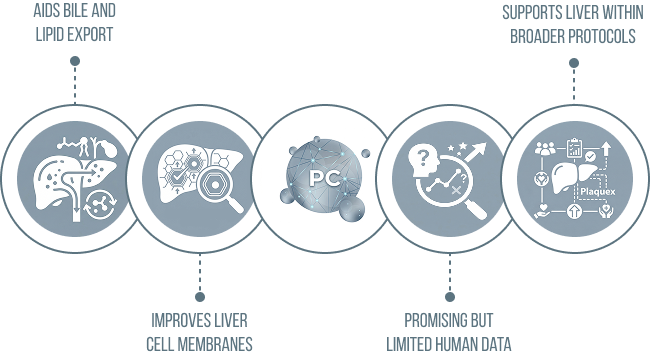
Phosphatidylcholine is a key structural component of bile – without adequate PC, bile composition changes and fat digestion is impaired. It’s also essential to the liver’s ability to package and export lipids. When PC levels in hepatocyte membranes decline, fat can begin to accumulate inside liver cells – a pattern associated with conditions like NAFLD.
A comprehensive 2024 review published in The Anatomical Record (Mak et al., Icahn School of Medicine at Mount Sinai) found that polyenylphosphatidylcholine – the same class of compound used in Plaquex – has been shown in experimental models to replenish PC content in hepatocyte membranes, improve membrane fluidity, attenuate fat accumulation, and reduce pro-inflammatory signaling in liver immune cells. These are preclinical findings, and translation to human clinical practice requires careful interpretation.
A real-world observational study published in BMJ Open Gastroenterology examined phosphatidylcholine as adjunctive therapy in patients with NAFLD and metabolic comorbidities, reporting improvements in liver enzyme profiles in a non-randomized, non-controlled setting. The findings are promising but require confirmation in randomized controlled trials.
Clinical evidence in humans remains limited and heterogeneous. No large-scale RCTs have established Plaquex as a standard-of-care intervention for hepatic conditions. It is used as a supportive, adjunctive measure within a broader protocol, not as a primary treatment.
Key Takeaway
- Phosphatidylcholine is essential to bile production and hepatic lipid export
- Experimental models show membrane-level benefits in liver tissue
- Observational human data is encouraging but not definitive
- Plaquex may support liver function as part of a broader protocol — not as a standalone treatment
The Brain Connection
Neurons are among the most membrane-rich cells in the body. Every signal your brain sends depends on precise communication between neurons, which in turn depends on the structural integrity of their membranes.
Phosphatidylcholine serves a dual role in neurological function. First, it’s a major structural component of the neuronal membrane itself. Second, it’s a precursor to acetylcholine – a neurotransmitter involved in memory, attention, and learning.
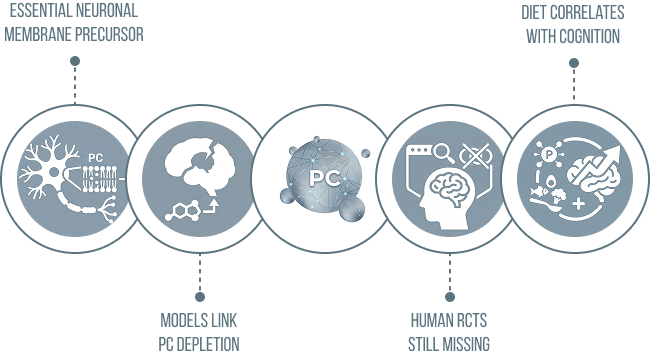
Here’s the biological bind: acetylcholine and phosphatidylcholine compete for the same choline pool. When choline availability drops, neurons have been observed in preclinical models to break down their own membrane PC to maintain neurotransmitter production – a process sometimes called “aucto-cannibalism.” Over time, this may degrade membrane integrity and contribute to cognitive symptoms including brain fog and mental fatigue. This mechanism is supported by preclinical data; its direct clinical significance in humans is still being studied.
A 2024 narrative review published in Clinical Nutrition ESPEN examined preclinical and observational evidence for PC’s role in neuroplasticity. The authors found that adequate neuronal PC content may activate signaling pathways associated with synaptic function and learning. Observational studies have also noted altered PC metabolism in patients with Alzheimer’s disease – though the authors caution that whether this is a cause or consequence of the disease remains unclear, and clinical applications in neurodegenerative conditions require further investigation.
A 2024 pilot study published in Frontiers in Neurology explored PC therapy in 29 patients with post-COVID cognitive impairment. Patients receiving PC showed a positive trend in cognitive scores across assessments, but results did not reach statistical significance in all groups. The study was small and uncontrolled; the authors called for larger randomized trials.
Population-level data from the Framingham Offspring Cohort (n = 1,391) found that higher dietary phosphatidylcholine intake was associated with better cognitive test performance and lower white-matter changes on brain MRI – though as an observational study, it does not establish causation.
Key Takeaway
- PC is structurally essential to neuronal membranes and is a precursor to acetylcholine
- Preclinical models show a plausible mechanism linking PC depletion to cognitive symptoms
- Human evidence is preliminary – no RCTs confirm PC therapy as a cognitive treatment
- Population data suggests an association between dietary PC intake and cognitive performance
Potential Risks and Limitations
As with any IV therapy, Plaquex is not without considerations. Patients should be aware of the following:
- Persistent fatigue and cognitive fog that hasn’t responded to conventional approaches
- Evidence of hepatic lipid accumulation or NAFLD in a metabolic context
- Lipid handling concerns in the absence of a clear structural cause
- Aging-related metabolic or cognitive concerns within a broader wellness protocol
Outcomes depend on individual metabolic context. Chronic inflammation, insulin resistance, poor sleep, and sedentary habits all create an environment that limits the effectiveness of membrane-level interventions. Plaquex works best as part of a comprehensive protocol, not as an isolated infusion.
IV Delivery: Why the Route of Administration Matters
Oral phosphatidylcholine supplements are subject to digestion and first-pass hepatic metabolism, which reduces the amount reaching target tissues intact. Intravenous therapy delivers PC directly into the bloodstream, bypassing these losses. This pharmacokinetic difference is the primary rationale for IV administration in clinical protocols.
Plaquex infusions are generally well tolerated. Sessions last approximately one hour, administered while you recline comfortably. The number of sessions is determined by clinical assessment and individual goals, not a fixed standard protocol.
How Invita Integrates Plaquex Into a Broader Protocol
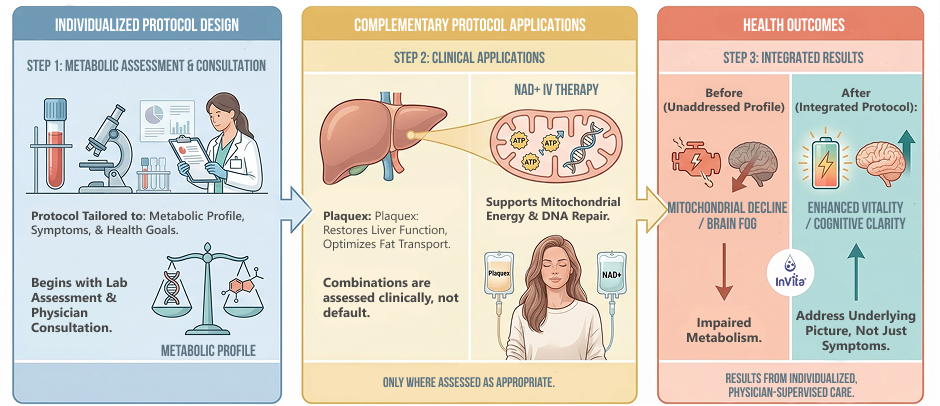
At Invita Wellness, Plaquex is used as one component within an individualized, physician-supervised protocol – tailored to your metabolic profile, symptoms, and health goals.
Depending on clinical goals, Plaquex may be combined with NAD+ IV therapy – which supports mitochondrial energy production and DNA repair – where this combination is appropriate for the individual patient. Not all patients require or benefit from combined protocols; this is determined through assessment, not as a default.
Effective results come from addressing the underlying metabolic picture, not just individual symptoms. Every protocol at Invita begins with lab assessment and a clinical consultation.
Membrane Health Is Often the Missing Piece
Every function your body performs – from metabolizing fat in the liver to firing a synapse in the brain – depends on healthy, fluid, well-composed cell membranes. Yet membrane health almost never comes up in standard clinical evaluations.
Plaquex therapy isn’t a cure. The evidence base is real but still developing, and it works best when embedded in a protocol that addresses lifestyle, metabolic function, and inflammation alongside membrane-level support. For people navigating fatigue, cognitive sluggishness, and metabolic concerns that standard approaches haven’t fully resolved, it represents a scientifically grounded avenue worth discussing with a qualified clinician.
Contact Invita Wellness today to explore whether phosphatidylcholine IV therapy fits your health strategy. Every protocol starts with a clinical consultation and individual assessment.
* Please note: Plaquex therapy is not a treatment for liver disease, neurological disorders, or any medical condition. It should not replace evidence-based medical care. Outcomes vary based on individual metabolic context. All IV therapies at Invita Wellness are administered under physician supervision. Consult a qualified healthcare provider before starting any new therapy.
Plaquex IV therapy is your health strategy
contact InVita Wellness today
Book Now
456 Broadway 2 Floor, New York, NY 10013, USA
Dr. Leon Shapiro
Medical Director & Protocol Specialist
Medically reviewed by Dr. Leon Shapiro, MD, Harvard-trained anesthesiologist with 25+ years in clinical and research settings. Formerly attending physician at Englewood Hospital (NJ). Curates and supervises InVita’s IV and NAD+ protocols, with extensive expertise in peptide therapy and hormone optimization.
Resources
Mak, K.H., et al. “Soybean polyenylphosphatidylcholine (PPC) is beneficial in liver and extrahepatic tissue injury: An update in experimental research.” The Anatomical Record 307.6 (2024): 2162–2186.
https://pubmed.ncbi.nlm.nih.gov/37814787/
Maev, I.V., et al. “Effectiveness of phosphatidylcholine in alleviating steatosis in patients with NAFLD and cardiometabolic comorbidities (MANPOWER study).” BMJ Open Gastroenterology 7.1 (2020): e000341.
https://pmc.ncbi.nlm.nih.gov/articles/PMC7170405/
Hotz, J.F., et al. “Exploring cognitive impairments and the efficacy of phosphatidylcholine in post-acute COVID-19 Syndrome.” Frontiers in Neurology 15 (2024): 1419134.
https://www.frontiersin.org/journals/neurology/articles/10.3389/fneur.2024.1419134/full
Azzini, E., et al. “Unlocking choline’s potential in Alzheimer’s disease: neuroprotective and neurotrophic role of phosphatidylcholine.” Clinical Nutrition ESPEN (2024).
https://www.sciencedirect.com/science/article/abs/pii/S2405457724013287
Poly, C., et al. “The relation of dietary choline to cognitive performance and white-matter hyperintensity in the Framingham Offspring Cohort.” American Journal of Clinical Nutrition 94.6 (2011): 1584–1591.
https://pmc.ncbi.nlm.nih.gov/articles/PMC3252552/