Dietary supplements represent a growing multi-billion dollar market as people look for alternative ways to boost their health and slow the aging process. But with so many individual supplements on the market, it’s easy to become confused. NAD+ (Nicotinamide Adenine Dinucleotide) and NAC (N-Acetylcysteine) are popular supplements with distinct roles in supporting human health.
Learn the difference between the two, and how you can get the most impact for your supplement dollars.
NAC vs NAD+ – What is the Difference?
Due to their similar acronyms, people often assume that NAD+ and NAC are two sides of the same coin, but that is not the case. NAD+ (nicotinamide adenine dinucleotide) and NAC (N-acetylcysteine) perform different functions in the human body that often complement one another.
Nicotinamide Adenine Dinucleotide (NAD)
NAD+ is a vital molecule present in every cell that plays a central role in energy production and metabolism. Your body manufactures its own NAD+ from dietary nutrients, but production peaks between ages 20-30. As people age, natural NAD+ levels gradually decline, causing degradation at the cellular level and contributing to characteristics of aging.
A nutrient-dense diet can help boost NAD+ production, but many turn to oral supplements to ensure adequate NAD+ precursors. Although the NAD+ molecule itself is too large to be effectively absorbed via oral pathways, oral precursors like nicotinamide mononucleotide (NMN) or injectable nicotinamide riboside (NR) – aka Niagen – can provide your cells with the nutrients they need to replenish NAD+ levels.
NAD+ is a coenzyme that participates in multiple
critical biological functions:
NAD+ is a coenzyme that participates in multiple critical biological functions:
- Energy Metabolism – NAD+ acts as a coenzyme in cellular mitochondria, facilitating the conversion of carbohydrates and fats into ATP, the energy molecule. Low NAD+ levels can impair energy metabolism, contributing to fatigue and metabolic disorders.
- DNA Repair and Genomic Stability – NAD+ serves as a substrate for enzymes involved in DNA repair, facilitating repair processes and maintaining genomic integrity. NAD+ depletion can slow DNA repair, accelerate aging, and contribute to disease progression.
- Regulation of Cellular Signaling – NAD+ is a cofactor for sirtuins, a family of proteins that regulate cellular processes like gene expression, stress response, and inflammation. NAD+ availability is linked to improved insulin sensitivity, reduced systemic inflammation, and protection against neurodegenerative diseases like Alzheimer’s and Parkinson’s.
- Defense Against Oxidative Stress – NAD+ supports antioxidant systems by aiding enzymes like glutathione reductase to regenerate glutathione, a key antioxidant that protects cells from oxidative damage.
- Immune Support and Reduced Inflammation – NAD+-dependent enzymes, such as sirtuins and PARPs regulate immune signaling pathways. NAD+ depletion during chronic inflammation can impair sirtuin activity, exacerbating inflammatory diseases like arthritis, diabetes, and heart disease.
- Combats Aging and Promotes Longevity – Declining NAD+ levels over time can impact multiple cellular processes, leading to impaired DNA repair, mitochondrial dysfunction, and metabolic dysregulation—all hallmarks of aging. NAD+ precursors like nicotinamide mononucleotide (NMN) and nicotinamide riboside (NR) show promise for extending both lifespan and healthspan.
- Neuroprotection and Cognitive Health – NAD+ enhances mitochondrial function in neurons, supports neuroprotection, and aids in repairing oxidative damage to brain cells. Higher NAD+ levels are associated with better cognitive function and reduced risk of neurodegenerative diseases.
- Cardiovascular Health – NAD+-dependent pathways regulate endothelial cell function, vascular tone, and cardiac energy metabolism, helping to protect against vascular aging and oxidative stress. Adequate NAD+ levels may reduce the risk of cardiovascular diseases like atherosclerosis and heart failure.
- Muscle Function and Exercise Performance – NAD+ supports mitochondrial activity in muscle cells, enhancing energy production and post-exercise recovery. Higher NAD+ levels may improve muscle endurance, strength, and recovery, particularly in older adults.
N-acetylcysteine (NAC)
N-Acetylcysteine (NAC) is a derivative of the amino acid cysteine and a precursor to glutathione (GSH), the body’s primary antioxidant. Its mucolytic, antioxidant, and anti-inflammatory properties make it a popular supplement for fighting respiratory infections and inflammatory conditions.
NAC contributes to many important biological processes:
NAC contributes to many important biological processes:
- Antioxidant Defense and Oxidative Stress Reduction – NAC acts as a scavenger of reactive oxygen and nitrogen species while replenishing GSH levels, to neutralize oxidative damage. Oxidative stress is linked to aging, chronic diseases, and toxicity, potentially increasing the risk of cancers and neurodegenerative disorders.
- Detoxification and Liver Protection – NAC is the standard antidote for acetaminophen overdose, which can cause serious liver damage. It restores depleted GSH in the liver to facilitate detoxification. NAC may also help combat drug-induced liver damage and heavy metal toxicity.
- Respiratory Health and Mucolytic Effects – NAC helps to thin mucus in conditions like chronic obstructive pulmonary disease (COPD), cystic fibrosis, bronchitis, pneumonia, and coronavirus, helping to improve respiratory function.
- Anti-Inflammatory and Immune Modulation – NAC reduces excess inflammation by boosting GSH. It also promotes survival signals in immune cells.
- Cognitive Health and Neurological Protection – NAC crosses the blood-brain barrier, reduces glutamate excitotoxicity, promotes neurogenesis, and counters oxidative stress in neurons. It upregulates protective proteins and modulates dopamine/glutamate balance. In conditions like Alzheimer’s and Parkinson’s, NAC may slow cognitive decline and protect against neuronal damage.
- Cardiovascular and Metabolic Health – NAC supports vascular function and metabolic regulation. It reduces inflammation in fat tissue to improve insulin sensitivity, enhances insulin signaling.
- Supports Reproductive Health – In women, NAC supports ovulation, and endometrial health and its mucolytic properties enhance cervical mucus. In men, NAC improves sperm quality and boosts male fertility parameters. It reduces oxidative damage to gametes, enhancing reproductive capacity.
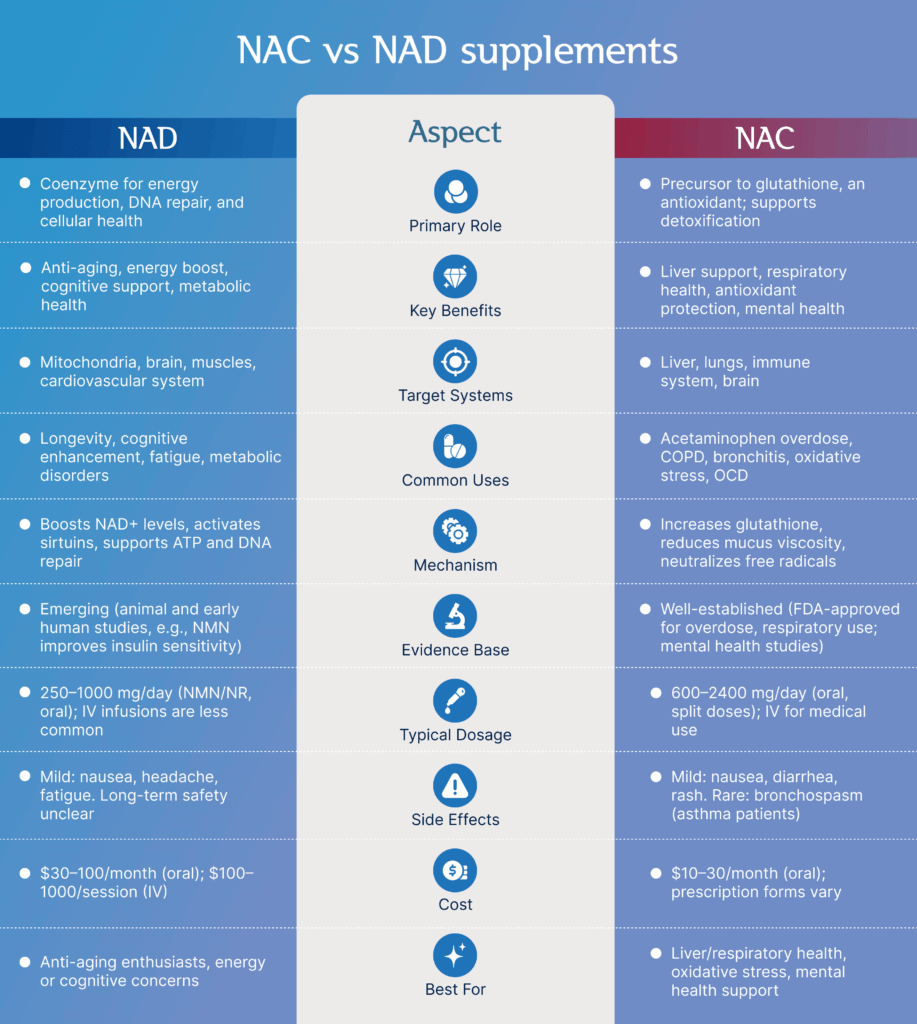
The following table gives a comparative overview of NAD and NAC:
| Aspect |
NAD |
NAC |
| Primary Role |
Coenzyme for energy production, DNA repair, and cellular health. |
Precursor to glutathione, an antioxidant; supports detoxification. |
| Key Benefits |
Anti-aging, energy boost, cognitive support, metabolic health. |
Liver support, respiratory health, antioxidant protection, mental health. |
| Target Systems |
Mitochondria, brain, muscles, cardiovascular system. |
Liver, lungs, immune system, brain. |
| Common Uses |
Longevity, cognitive enhancement, fatigue, metabolic disorders. |
Acetaminophen overdose, COPD, bronchitis, oxidative stress, OCD. |
| Mechanism |
Boosts NAD+ levels, activates sirtuins, supports ATP and DNA repair. |
Increases glutathione, reduces mucus viscosity, neutralizes free radicals. |
| Evidence Base |
Emerging (animal and early human studies, e.g., NMN improves insulin sensitivity). |
Well-established (FDA-approved for overdose, respiratory use; mental health studies). |
| Typical Dosage |
250–1000 mg/day (NMN/NR, oral); IV infusions are less common. |
600–2400 mg/day (oral, split doses); IV for medical use. |
| Side Effects |
Mild: nausea, headache, fatigue. Long-term safety unclear. |
Mild: nausea, diarrhea, rash. Rare: bronchospasm (asthma patients). |
| Cost |
$30–100/month (oral); $100–1000/session (IV). |
$10–30/month (oral); prescription forms vary. |
| Best For |
Anti-aging enthusiasts, energy or cognitive concerns. |
Liver/respiratory health, oxidative stress, mental health support. |
Two Powerful Nutrients with Mutual Benefits
NAC and NAD both play critical and complementary roles in human health, impacting many of the same systems in different ways. While your body makes both from dietary nutrients, modern diets may not provide ample amounts to meet your biological needs. Supplementing NAC, and NAD+ and its precursors, can help to ensure that your cells have the support they need to function at their best.
NAC is readily available as an oral supplement, and is relatively inexpensive. NAD+ precursors like NMN and NR (aka Niagen) can also be found in oral form, although the NAD+ molecule itself is too large to be effectively absorbed via oral pathways. NAD+ is most effective when delivered by intravenous infusion. A pharmaceutical-grade form of Niagen – nicotinamide riboside chloride – is a potent NAD supplement available as an injectable.
Support Health and Combat Aging with NAD+ Therapy in NYC
It’s easy to take your health for granted as long as you have enough energy to meet the challenges of daily living. But over time, performance may diminish, especially if your diet does not provide ample nutrients to meet your needs. Oral supplements can help, but they are often poorly absorbed, and quality and potency can vary from one brand to the next.
At Invita Wellness, conveniently located in Manhattan’s fashionable SoHo district, we provide a broad range of high-quality nutrient supplement infusions and injections, designed to support biological functions and metabolic health. Our potent NAD+ infusions and Niagen injections can help to boost cellular NAD+, to combat aging, boost energy, and promote longevity.
Contact Invita Wellness today, and take charge of your health with Niagen and NAD+ infusion therapy in NYC.
*Please note: NAD+ is a nutrient coenzyme, not a medication. It should not be considered an alternative to medical advice or pharmaceutical prescriptions from your health care provider. Consult your doctor if you have concerns about NAD+ therapy.
Get the Best NAD+ IV Therapy in NYC
contact InVita Wellness today
Book Now
456 Broadway 2 Floor, New York, NY 10013, USA
Resources
Chaudary, Alice. “NAD IV Therapy: Benefits, Risks, and What to Expect from This Cellular Health Treatment.”
NAD IV Therapy: Benefits, Risks, and What to Expect from This Cellular Health Treatment
Tenório, Micaely Cristina dos Santos, et al. “N-acetylcysteine (NAC): impacts on human health.” Antioxidants 10.6 (2021): 967.
N-Acetylcysteine (NAC): Impacts on Human Health