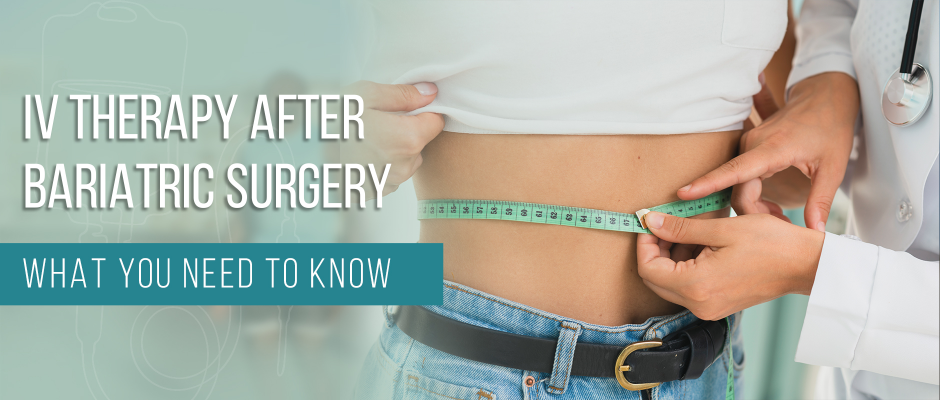
Bariatric surgery changes your life. It also permanently changes the way your body absorbs nutrients and for many patients, that’s where the problems begin.
You’re taking your supplements. You’re following the plan. But you’re still exhausted, your blood tests still show deficiencies, and nobody seems to have a clear answer for why.
The reason, in most cases, is straightforward: your digestive system has been surgically altered, and oral supplements can only do so much when the gut designed to absorb them has been rerouted or reduced. IV therapy exists to fill that gap.
Why Bariatric Surgery Creates a Nutritional Problem
When your stomach is made smaller or your digestive tract is rerouted, your body loses access to the sections of the gut that absorb specific nutrients most efficiently.
In a gastric bypass, food bypasses the duodenum, the part of the small intestine responsible for absorbing iron, calcium, zinc, and several B vitamins. In a sleeve gastrectomy, reduced stomach size means less stomach acid and less intrinsic factor, the protein your body needs to absorb vitamin B12.

The result is that even patients who take their supplements consistently can develop serious deficiencies over time. A 2025 meta-analysis of 74 studies in over 12,000 RYGB patients found that anemia prevalence rises from 15% within the first year to 35% beyond five years post-surgery, with iron and vitamin B12 deficiency identified as the dominant drivers. The ASMBS guidelines therefore recommend protocolised long-term monitoring and supplementation across all bariatric procedures.
Why Oral Supplements Often Aren’t Enough
There are four reasons oral supplementation frequently falls short after bariatric surgery.
- The stomach acid is lessened, which prevents the activation of nutrients, such as iron and B12, before absorption.
- Absorbed bypassed areas means supplements are not absorbed at the area of the gut most suited to absorption.
- Nausea and cramping, especially with iron, that many patients do not want to admit to reducing their dose or stopping taking it.
- Absorption is unpredictable, so blood tests may appear to be close to normal, but the cells may still be low.
All this is not the patient’s fault. This is an inevitable result of the way the procedures operate.
What IV Therapy Does Differently
Intravenous therapy is the direct injection of vitamins, minerals and fluids into the bloodstream via a small cannula, usually inserted into the arm. Nutrients are not digested at all so absorption is 100% (even if the gut has been altered).

This is the main benefit. IV therapy doesn’t rely on the part of the body that surgery has changed.
A session can take between 30 minutes and a couple of hours, depending on the substance being administered. You will be supervised all the way. It is much easier than most patients think and most people are able to return to regular activity right after the procedure.
The Key Benefits for Bariatric Patients
1. More rapid correction of deficiencies.
If iron, B12 or other nutrients are dangerously low, IV therapy can replenish levels much faster than oral supplementation (weeks instead of months).
2. Improved energy.
Iron, B12, magnesium and B vitamins are all involved in energy production. Replacing deficiencies with intravenous supplementation often yields significant results in terms of alleviating symptoms of fatigue which patients have been dealing with for years.
3. Neurological protection.
Both B12 and thiamine deficiencies are potentially neurotoxic. Prolonged B12 deficiency may lead to permanent nerve damage. Thiamine deficiency may cause Wernicke’s encephalopathy, a neurological emergency that has been reported after all types of bariatric surgery and is reversed by prompt intravenous thiamine. Both are more effectively delivered parenterally than orally.
4. More tolerant than oral supplements.
According to a 2019 review in Acta Haematologica, up to 70% of patients on oral iron report gastrointestinal side effects (nausea, cramping, constipation), while IV iron bypasses the gut entirely. If a patient really cannot take oral iron, it should be given intravenously, not as an alternative.
5. Hair and immune health support.
Patients post-bariatric often experience hair regrowth and immune function issues, which are all supported by zinc, vitamin C and sufficient iron. IV formulations can help correct any deficiencies that may be causing these symptoms sooner than oral formulations.
6. Hydration support.
Many patients who have undergone bariatric surgery have a hard time consuming enough water because of the size of their stomachs. IV hydration is direct repletion if oral hydration is inadequate.
The Most Important Nutrients to Monitor
| Nutrient |
Risk After Surgery |
Why IV Matters |
| Iron |
Very high, especially after bypass |
Oral iron poorly tolerated and poorly absorbed |
| Vitamin B12 |
High in all procedures |
Requires intrinsic factor – IV bypasses this |
| Vitamin D |
Common, especially BPD/DS |
Fat malabsorption limits oral uptake |
| Magnesium |
Frequently missed |
Oral doses cause diarrhoea at therapeutic levels |
| Thiamine |
Can become critical within weeks |
IV essential in acute deficiency |
| Zinc |
Common, often overlooked |
Linked to hair loss and immune problems |
Is IV Therapy Safe?
Yes, if given by trained clinicians in an appropriate setting. The main risks are:
Allergic reactions, rare but can happen, especially when receiving iron infusions. Any reputable provider will have procedures to deal with these. Minor and temporary irritation of the veins with regular use. Nutrient toxicity (only a risk if IV therapy is administered without blood monitoring). Fat-soluble vitamins should not be given if there is no known deficiency.
Blood tests should always be used to guide IV therapy. Established post-bariatric monitoring schedules recommend regular checks of full blood count, ferritin, vitamin B12, folate, vitamin D, calcium, and other micronutrients depending on the procedure. Regular infusions without checking on bloodwork aren’t appropriate and any provider that doesn’t request bloodwork before giving you an infusion is a provider you should stay away from.
What to Ask Your Health Care Team
- What blood tests are ordered at my next review and does it include the complete post-bariatric blood panel?
- Do my current supplements correspond to the type of surgery I had?
- Given my results and symptoms, should I be considering IV therapy?
- Do you know of any specialist that deals with IV nutrition for bariatric patients?
A Final Word
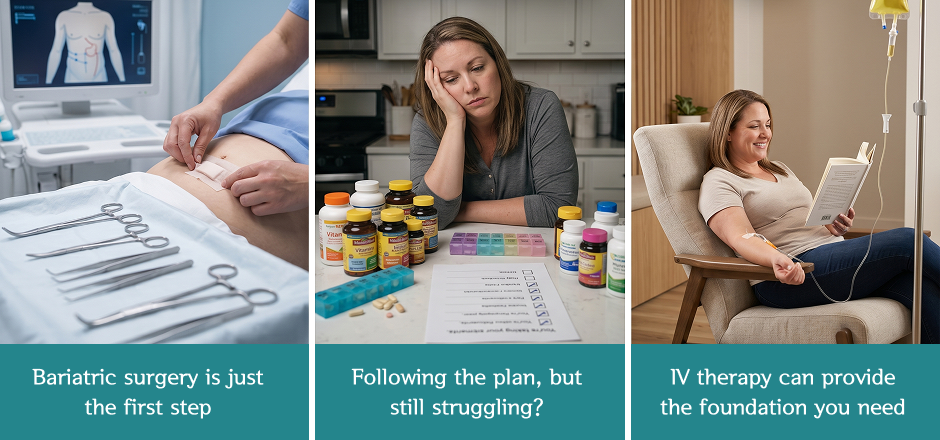
Failure to maintain proper nutrition after bariatric surgery is not a failure of the surgery. This is a recognized and predictable outcome of an irreversible change in the digestive system. Oral supplementation is a key element and in many cases not the only element of a solid foundation.
In some instances, the gut is no longer able to perform its duties well, and IV therapy can provide a reliable and well-tolerated means of providing what the body needs. It is one of the most clinically useful tools to use in conjunction with routine blood testing and oral supplementation when managing long-term post-bariatric health.
If you’re still having trouble despite all of the measures you’ve been advised to take ask if IV therapy is part of your treatment plan. It means a great deal to many patients.
This article is not intended to be a medical diagnosis or treatment and should not be used as such. Please do not alter your care without consulting your bariatric surgeon, dietitian or GP first.
Book your first session at InVita Wellness, SoHo NYC
contact InVita Wellness today
Book Now
456 Broadway 2 Floor, New York, NY 10013, USA
Dr. Leon Shapiro
Medical Director & Protocol Specialist
Medically reviewed by Dr. Leon Shapiro, MD, Harvard-trained anesthesiologist with 25+ years in clinical and research settings. Formerly attending physician at Englewood Hospital (NJ). Curates and supervises InVita’s IV and NAD+ protocols, with extensive expertise in peptide therapy and hormone optimization.
Resources
Parrott J, Frank L, Rabena R, Craggs-Dino L, Isom KA, Greiman L. American Society for Metabolic and Bariatric Surgery Integrated Health Nutritional Guidelines for the Surgical Weight Loss Patient 2016 Update: Micronutrients. Surgery for Obesity and Related Diseases. 2017;13(5):727-741.
[ASMBS] asmbs.org
Lim R, Beekley A, Johnson DC, Davis KA. Medical Management of the Post Operative Bariatric Surgery Patient. In: Feingold KR, et al., editors. Endotext. South Dartmouth (MA): MDText.com; 2024.
[NCBI Bookshelf] ncbi.nlm.nih.gov
O’Kane M, Parretti HM, Pinkney J, et al. British Obesity and Metabolic Surgery Society Guidelines on perioperative and postoperative biochemical monitoring and micronutrient replacement for patients undergoing bariatric surgery — 2020 update. Obesity Reviews. 2020;21(11):e13087.
[PMC] ncbi.nlm.nih.gov
Prevalence and correlates of anemia following Roux-en-Y gastric bypass: a systematic review and meta-analysis. Obesity Surgery. 2025 [systematic review of 74 studies, 12,262 patients].
[PubMed] pubmed.ncbi.nlm.nih.gov
DeLoughery TG. Safety of Oral and Intravenous Iron. Acta Haematologica. 2019;142(1):8-12.
[PubMed] pubmed.ncbi.nlm.nih.gov
Sechi G, Bardanzellu F, Pintus MC, Sechi MM, Marrosu MG, Serra A. Case Report: Wernicke Encephalopathy Following Roux-en-Y Gastric Bypass. American Family Physician. 2020;102(4):197-199.
[Full text] aafp.org