Reviewed for Clinical Accuracy by the InVita Wellness Clinical Team

Men aged 45-65 tend to say the same thing in different words. Energy is no longer found in nature but must be produced. The body ceases to react to the diet and training that once worked. Recovery drags. Sleep stops paying for itself.
Most of this goes into normal aging and stays there. Some of it is measurable. The amount of growth hormone produced in the body, as well as the levels of the male hormone, testosterone, and the cellular signaling pathways involved in energy production and tissue repair all change with age, and these changes are reflected in a lab panel.
Peptide therapy is part of preventive and longevity medicine, which involves how to interact with those signals. What follows is an overview of peptides, which compounds are supported by real evidence, where the regulatory landscape is and what a physician-led program entails at InVita Wellness. Whether or not this applies to you is a clinical question and is determined by evaluation and lab work, not by an article.
Quick Answer
- Short chains of amino acids that act as “signaling molecules” are peptides.
- In men’s health the compounds most often used are growth hormone secretagogues such as sermorelin, ipamorelin, CJC-1295 and tesamorelin, recovery peptides such as BPC-157 and TB-500, and hormonal support compounds such as PT-141 and kisspeptin.
- There are only two FDA approved drugs, namely, tesamorelin and bremelanotide, which are both approved for indications other than general male wellness, and therefore are off label for this purpose.
- Laboratory assessment of IGF-1, fasting insulin, testosterone, thyroid and cortisol, not symptoms, is used to determine candidacy.
Medical Disclaimer
This article is for informational purposes only and should not be considered medical advice. Some of the compounds listed are not FDA approved for any indication and some are used off label. Regulatory and compounding status is changing actively through 2026 and may have moved since publication. This is not a place to determine if peptide therapy is right for you. A physician evaluation and lab tests are necessary to determine that.
Why Energy and Body Composition Change After 45
Growth hormone production starts to decline in early adulthood and continues to decrease. It has a name, somatopause, and at 70 years of age, secretion is about 60 percent of that of a young adult. The liver produces IGF-1 in response to growth hormone activity, and it is the most commonly used clinical indicator of growth hormone activity, along with being one of the earliest markers examined before any protocol is even considered.
The consequences are real. Growth hormone preserves lean mass and bone, stimulates lipolysis to reduce visceral fat, and affects glucose uptake and aerobic fitness. The Endotext review on growth hormone and aging points out that the physical changes of old age are similar to those of adult growth hormone deficiency, but adds that resemblance does not imply cause.
Testosterone does, too, at about 1 percent a year after age 30. The point that is frequently overlooked is that the majority of this apparent effect of age on LH was shown to be due to accumulated comorbidity, especially obesity, reducing LH secretion, according to the European Male Ageing Study. It’s for this reason that a lab panel is more telling than a birth year.
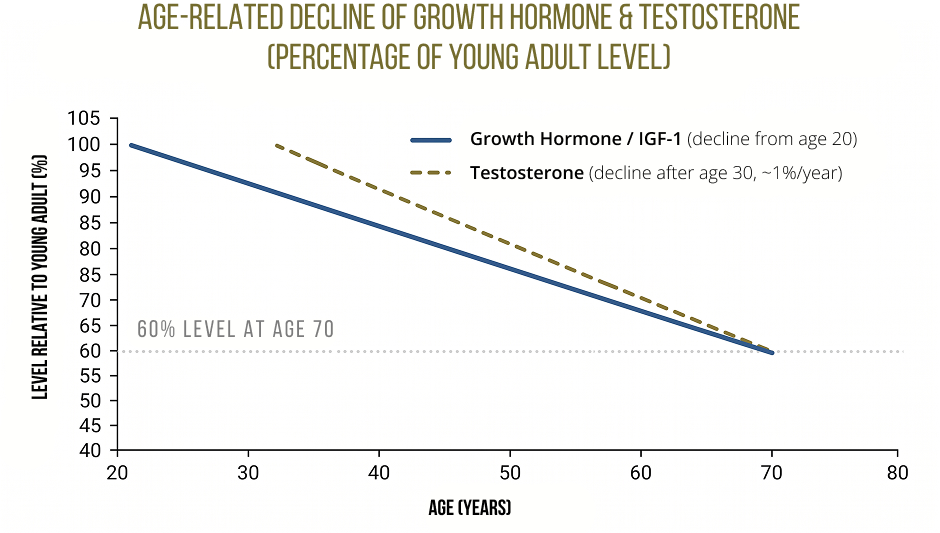
A combination of two hormones that are both decreasing results in a metabolic state that is conducive to fat storage, is anti-muscular, and slows recovery. They are accompanied by reduced responsiveness of cellular repair and mitochondrial function. That is the recipe for what men are saying when they say that the same effort isn’t yielding the same results.
What Peptide Therapy Is, and What It Is Not
Short chains of amino acids, called peptides, are signaling molecules. They are produced in the body in thousands. Therapeutic peptides employed in clinical applications are biological or closely related to body-produced peptides and do not replace a biological function directly, but function via the existing signaling pathways.
Growth hormone releasing peptides are a case in point. They do not contain synthetic growth hormones. They stimulate the pituitary to secrete additional, in pulses that remain in more natural proportions. This is the mechanism-based rationale for peptide therapy in general, and it is a true distinction, not necessarily a promise of benefit.
Peptide therapy is not a quick fix either. The results are not consistent and the method is not suitable for all men who identify with the symptoms listed above. Candidacy is not based on the degree of match with a description.
Growth Hormone Peptides
Sermorelin
Sermorelin is a GHRH analogue that can stimulate the natural release of GH from the pituitary. In clinical application, regular administration has been correlated with better sleep quality and slow changes in body composition and recovery ability in some men. Each person’s results vary and there is no guarantee of any particular outcome or time period.
Ipamorelin
Ipamorelin is a selective growth hormone secretagogue. It is unique among the class of compounds for its ability to stimulate growth hormone release without an associated increase in ACTH, cortisol or prolactin, even at doses well beyond the effective range, as determined by Raun and colleagues in 1998. Let’s be specific about the evidence here. That selectivity was shown in pigs and rats, and not in a large human trial, and ipamorelin hasn’t been FDA approved. The mechanical case is clean. There is limited human outcome data.
CJC-1295
CJC-1295 is a longer acting GHRH analogue, frequently paired with ipamorelin on the theory that combining a GHRH signal with a ghrelin receptor signal produces more sustained secretion than either alone. In appropriate candidates this pairing may support steadier growth hormone patterns. It requires physician assessment and it carries the same regulatory caveat as the rest of this group.
Tesamorelin
Tesamorelin has by some distance the strongest formal evidence base of this group, and it is the only FDA approved GHRH analogue. The approval is narrow. It covers visceral fat reduction in HIV positive clients with lipodystrophy, established through the 2007 NEJM trial that used CT measured visceral adipose tissue as its primary endpoint.
Growth Hormone Peptides
Sermorelin
Sermorelin is a GHRH analogue that stimulates natural pituitary GH release. Regular use is linked in some men to improved sleep, body composition, and recovery, though results and timelines vary.
Ipamorelin
Ipamorelin is a selective growth hormone secretagogue that stimulates natural GH release without raising cortisol or prolactin (based on animal studies). Human outcome data remains limited despite a clear mechanism.
CJC-1295
CJC-1295 is a long-acting GHRH analogue often paired with ipamorelin to create steadier growth hormone patterns through combined signals. Like the others, it requires physician oversight and lacks regulatory approval.
Tesamorelin
Tesamorelin has the strongest formal evidence base of this group and is the only FDA-approved GHRH analogue, though for a narrow indication: reducing visceral fat in HIV-positive clients with lipodystrophy.
Pooled phase III data showed visceral adipose tissue falling by 15 to 20 percent over six to twelve months in that population. Use in a general wellness context, in men without an HIV lipodystrophy diagnosis, is off label. Off label prescribing is legal and routine, but it means the outcomes in men like you have not been established through the process that supports the approved indication. A physician should raise that distinction unprompted during any tesamorelin conversation.
Recovery Peptides, BPC-157 and TB-500
BPC-157
BPC-157 has been studied for tendon and ligament healing, muscle repair, gut integrity and anti-inflammatory activity. The honest summary of that literature comes from a 2025 systematic review in HSS Journal, which screened 544 articles and included 36. Thirty-five were preclinical. One was clinical. The animal data are genuinely consistent across muscle, tendon, ligament and bone injury models. The human data barely exist.
TB-500
TB-500 is a synthetic fragment corresponding to an active region of thymosin beta-4, and the two names get used interchangeably even though they are not the same molecule. It works differently. It binds intracellular actin and accelerates fibroblast and endothelial cell migration, which is why it is discussed alongside BPC-157 rather than as a substitute for it. Human evidence is at a similar early stage.
Both compounds sit outside the scope of recovery and athletic protocols for anyone competing in a tested sport, because both appear on the WADA prohibited list. The same applies to the growth hormone peptides covered above. Sermorelin, ipamorelin, CJC-1295 and tesamorelin all fall under section S2.2 of the 2026 list, which covers growth hormone together with its releasing factors and secretagogues, and that prohibition holds in and out of competition. If you compete, say so at the consultation before anything else is discussed.
Hormonal Support Peptides
PT-141 (Bremelanotide)
PT-141 acts through melanocortin receptors in the central nervous system rather than peripherally, which distinguishes it from PDE5 inhibitors. It is FDA approved as Vyleesi for hypoactive sexual desire disorder in premenopausal women, on the strength of the RECONNECT phase III trials. Two things men should know before this comes up in conversation.
- The FDA label states explicitly that Vyleesi is not indicated in men, and not indicated to enhance sexual performance. Any use in men is off label.
- It is contraindicated in uncontrolled hypertension or known cardiovascular disease, and it produces a transient blood pressure rise after every dose that usually resolves within twelve hours
That cardiovascular profile is the reason a blood pressure reading and a cardiac history are not optional before this compound is considered.
Kisspeptin
Kisspeptin sits at the top of the hypothalamic pituitary gonadal axis, upstream of GnRH. In the first human male study, Dhillo and colleagues infused kisspeptin-54 into six volunteers and recorded significant rises in LH, FSH and testosterone against saline. Six volunteers is a proof of mechanism, not a treatment evidence base, and later work found that testosterone response falls off with age even where the pituitary response holds. Clinical application should be treated as investigational. Kisspeptin is not FDA approved for any indication, and it requires an intact pituitary and intact gonads to do anything at all. Kisspeptin-10 also sits in Category 2 of the FDA interim 503A list, which means compounding pharmacies cannot use it, and the advisory committee voted against adding it to the bulks list in October 2024.
Recovery Peptides
BPC-157
BPC-157 shows consistent preclinical tissue-repair data across animal models, but human data are virtually nonexistent, with a 2025 HSS Journal review finding only one clinical study among 36 included papers.
TB-500
TB-500 is a synthetic fragment of thymosin beta-4 that accelerates cell migration by binding actin. Discussed alongside BPC-157 for complementary mechanisms, it similarly lacks robust human data.
Hormonal Support Peptides
PT-141 (Bremelanotide)
PT-141 acts centrally via melanocortin receptors. FDA-approved as Vyleesi for women, its use in men is off-label and contraindicated in cardiovascular disease due to temporary blood pressure spikes.
Kisspeptin
Kisspeptin sits upstream of GnRH, boosting testosterone in early trials, but human data are limited and responses decline with age. It lacks FDA approval, requires intact axes, and faces compounding restrictions.
Where the Regulation Actually Stands in 2026
This is the part most articles get wrong, usually by being six months out of date. On 23 and 24 July 2026 the FDA’s Pharmacy Compounding Advisory Committee reviewed seven bulk substances for inclusion on the 503A Bulks List. That list is one of the statutory conditions under which state licensed compounding pharmacies may prepare a compound against a prescription. It is not a blanket authorization on its own, because Section 503A sets further federal conditions and state pharmacy law applies on top of them.
FDA staff had recommended against all seven. The committee recommended six of them anyway. BPC-157, KPV and TB-500 each passed by 8 votes to 6 with one abstention. MOTS-c passed 7 to 5 with two abstentions. On the second day Semax passed 8 to 5 and Epitalon passed 7 to 5, each with one abstention. Emideltide, also known as DSIP, was voted down 6 to 7 with one abstention, the only rejection across the two days.
Two caveats matter more than the headline. The committee is advisory, so its recommendation does not by itself change what a pharmacy may compound. Actual placement on the 503A list requires formal rulemaking, which has not been completed. And a favorable vote is not a safety finding. The FDA reviewers who recommended against these substances cited gaps in characterization, effectiveness and safety data, and those gaps did not close because a vote went the other way.
The practical implication for a client is simple enough. Sourcing and prescribing decisions on these compounds should be confirmed at the time of consultation rather than assumed from anything written earlier, including this page.
Evidence and Status at a Glance
Compound
What is it intended to do?
How strong is the human evidence?
What is the FDA status?
Sermorelin
Stimulate natural GH release via GHRH pathway
Historical clinical use, limited modern trial data in healthy aging men
Previously approved for pediatric GH deficiency, now used off label in adults
Ipamorelin
Selective GH release without cortisol or prolactin effects
Selectivity shown in animal models. No large human efficacy trial
Not approved
CJC-1295
Extend GHRH signaling, usually paired with ipamorelin
Some human pharmacokinetic work. Outcome data limited
Not approved. Removed from Category 2 in September 2024. The advisory committee voted against adding it to the 503A Bulks List in December 2024
Tesamorelin
Reduce visceral adipose tissue
Strongest of the group. Phase III RCTs with CT measured endpoints
Approved for HIV lipodystrophy only. Off label elsewhere
BPC-157
Tissue repair, gut integrity, anti-inflammatory
35 preclinical studies to 1 clinical study in a 2025 systematic review
Not approved. Favorable advisory vote July 2026, rulemaking pending. WADA prohibited
TB-500
Cell migration and tissue repair
Early stage. Predominantly preclinical
Not approved. Favorable advisory vote July 2026, rulemaking pending. WADA prohibited
Epitalon
Telomere biology, sleep quality
Limited and mostly from a single research group
Not approved. Favorable advisory vote July 2026, rulemaking pending
PT-141
Libido via central melanocortin receptors
Phase III RCTs, but in premenopausal women
Approved as Vyleesi for HSDD in premenopausal women. Label states not indicated in men
Kisspeptin
Upstream stimulation of the HPG axis
Small human infusion studies. Proof of mechanism
Not approved
Who May Be a Candidate
Strong candidates tend to share four things.
- Relevant laboratory findings, such as declining IGF-1, elevated fasting insulin, or metabolic markers consistent with reduced growth hormone activity.
- Foundations already in place, meaning resistance training, adequate sleep and adequate protein and nutrition. Peptides amplify a signal that has to already be there.
- Realistic expectations and a long horizon. Meaningful change emerges over weeks to months, not days.
- Willingness to run a monitored protocol with follow up bloodwork, rather than treat this as a one time intervention.
Who Is Not a Candidate
Some of these are absolute, some require careful physician review. All of them need to surface before a protocol is written, not after.
- Active malignancy or a history of hormone sensitive cancer. IGF-1 has mitogenic properties, so GH stimulating peptides require specialist review in this context.
- Uncontrolled metabolic disease. Poorly controlled diabetes or significantly elevated fasting insulin usually needs stabilizing first.
- Uncontrolled hypertension or known cardiovascular disease, specifically for PT-141, which is contraindicated in both.
- Competitive athletes in tested sport. BPC-157, TB-500 and MOTS-c are on the WADA prohibited list, and so are the growth hormone peptides discussed here, under section S2.2.
- Symptoms that have not been diagnostically worked up. Fatigue and weight change can reflect thyroid disease, sleep apnea, anemia, depression or malignancy, and those need excluding first.
- Unwillingness to maintain lifestyle foundations. Peptides are a multiplier rather than a replacement, and if the foundations are not there, there is not much to multiply.
When to seek immediate care rather than a wellness consultation
Unexplained weight loss, drenching night sweats, a new or changing lump, blood in stool or urine, chest pain or breathlessness on exertion, or fatigue that has come on abruptly over days rather than gradually over years. These are not peptide questions. They warrant a prompt physician assessment or emergency care, depending on severity.
What Peptide Therapy Cannot Do
- It cannot restore growth hormone or testosterone to the levels of a 25 year old, and no responsible protocol targets that.
- It cannot substitute for resistance training, sleep or protein intake. Every mechanism described here works downstream of those.
- It cannot treat an undiagnosed condition, and pursuing it in place of a diagnostic workup delays care.
- It cannot offer the certainty that an approved drug with a completed trial program offers. For most of these compounds the human evidence is early, and that should be priced into the decision.
- It cannot be assessed by symptoms alone. Two men with identical complaints can have entirely different lab pictures and entirely different appropriate answers.
How Programs Work at InVita Wellness

1
Consultation and laboratory evaluation
The process starts with a physician consultation to review history, symptoms, and goals. No protocol is recommended until baseline labs, including IGF-1, metabolic markers, lipids, and hormones are reviewed.

2
Protocol development
The program is developed based on the evaluation results and the goals of each individual, including compound selection, dosage, timing and delivery method. Peptide injection therapy is often combined with other treatments.

3
Monitoring
Protocols include scheduled follow-ups, regular IGF-1 re-evaluations, and dosage adjustments. Sourcing and prescriptions are also reassessed if regulatory or compounding status changes.
Consultation and laboratory evaluation
It begins with a physician consultation, which is a clinical dialogue, not a sales presentation. A health history, current medications, symptoms, lifestyle and goals are reviewed by the InVita Wellness Clinical Team. Prior to laboratory results being available and reviewed, no protocol is recommended.
Common baseline markers are IGF-1, fasting insulin, glucose, comprehensive metabolic panel, lipid panel, total and free testosterone, thyroid panel, and cortisol (if clinically indicated).
Protocol development
The program is developed based on the evaluation results and the goals of each individual, including compound selection, dosage, timing and delivery method. Peptide injection therapy is often combined with other treatments.
- NAD+ therapy at the mitochondrial level to produce cellular energy
- Direct bioavailability of vitamins, minerals and amino acids via IV nutrient therapy
- Cryotherapy for recovery and inflammation after training
- Metabolic wellness programs that focus on glucose regulation, insulin sensitivity and body composition
- Testosterone therapy – where the hormonal picture indicates it
1
NAD+ therapy at the mitochondrial level to produce cellular energy

2
Direct IV delivery of vitamins, minerals, and amino acids.

3
Cryotherapy for recovery and inflammation after training

4
Metabolic wellness programs focused on glucose, insulin, and body composition

5
Testosterone therapy – where the hormonal picture indicates it
Monitoring
Scheduled follow up, re-evaluation of IGF-1 at appropriate intervals and adjustment based on response are included in protocols. If the regulatory or compounding status of a compound changes during the program, sourcing and prescribing decisions are reassessed at that point.
Frequently Asked Questions
What is peptide therapy?
This is a broad term, in truth. It involves working with a signaling pathway that the body already uses, instead of replacing a hormone altogether, with specific short amino acid chains. In men, it typically involves stimulating the pituitary gland to produce more growth hormone, or helping the tissues rebuild, or affecting the reproductive axis. What it doesn’t mean is one standard treatment. The dosage, length of treatment and the compound depends on the laboratory results.
What peptides increase testosterone?
Look, here is where marketing comes before science. The action of kisspeptin is the most upstream, on the GnRH neurons in the hypothalamus, and there was human infusion studies that did show increases in LH, FSH and testosterone. However, those studies were small, the effect of testosterone decreases with age and requires intact pituitary and intact testes to have any effect. Growth hormone peptides do not actually increase the levels of testosterone. That is a different discussion and treatment if it is a true low T.
Are collagen peptides the same as peptide therapy?
No, and this is one of the words that people always get mixed up with. Collagen peptides are an oral food supplement, which are digested and broken down like all other proteins, and have been studied primarily for skin, joint and body composition support in conjunction with resistance training. The peptides described in this article are prescribed compounds, usually injected, that act as specific receptor signals. Collagen peptides are used by men and many are. It’s just a different type of category, for a different purpose.
Is peptide therapy safe?
Yeah, that depends entirely on which compound, which client and which pharmacy. The safety data from a completed phase III study with tesamorelin is available. Human safety data for BPC-157 are very limited, one clinical study against thirty five preclinical ones in the 2025 systematic review, and the FDA reviewers who assessed it in 2026 pointed to unresolved gaps in characterization and safety. There is a definite cardiovascular contraindication to PT-141. And it is a different risk altogether if you get your product from the grey market, as purity and the correct dose cannot be guaranteed. That’s why it is important for physicians to be involved and for verified pharmacies to be involved.
Does peptide therapy work?
Yes, in some instances and some endpoints, with actual trial evidence. Tesamorelin reduced visceral adipose tissue in phase III trials, in adults with HIV associated lipodystrophy, with CT measured endpoints. That result belongs to that population and that indication. The mechanism in most of the remaining is plausible, animal data supportive, and human outcome data thin. If someone tells you anything less, then they are selling something.
How much does peptide therapy cost, and does insurance cover it?
Coverage varies by plan, product and indication, and off label or unapproved uses are frequently not covered. The cost depends on the compound, dose and duration of the program, and is quoted only after evaluation, and not before, because the protocol is not known until the lab work is. For some clients, the consultation and lab work is enough even if they do not have a protocol.
Is 45 too early, or 65 too late?
Neither, really. Age is a weak predictor here. What predicts response is the lab picture, specifically IGF-1 relative to age adjusted reference, fasting insulin, and whether the foundational habits are in place. A well trained 62 year old with declining IGF-1 is a better candidate than a sedentary 46 year old with normal markers.
Is a Peptide Program Right for You?
Curious whether your lab work supports a protocol? That is exactly what a physician evaluation is designed to determine, and it is not a symptom checklist or a comparison of which compound sounds most appealing.
Here is what happens after you book. A member of the InVita team confirms your appointment within one business day. Before the visit you complete a short intake covering health history, medications and goals. At the consultation he reviews your history, discusses your goals, and outlines what a laboratory evaluation would involve. Lab work is ordered before any protocol is discussed. There is no package presentation and no obligation to proceed. If peptide therapy is not the right clinical fit, you will be told that directly, along with what does make sense.
InVita Wellness is located in SoHo, New York City, serving clients from Manhattan, Brooklyn and the surrounding metropolitan area.
Explore peptide therapy
contact InVita Wellness today
Book Now
456 Broadway 2 Floor, New York, NY 10013, USA
This article is for informational purposes only and does not constitute medical advice. Several therapies discussed are used off label or are not FDA approved. Regulatory status is subject to change. Individual results vary and are not guaranteed. Consult a qualified physician before beginning any new health or wellness program.
References
- Junnila RK, List EO, Berryman DE, Murrey JW, Kopchick JJ. The GH/IGF-1 axis in ageing and longevity. Nat Rev Endocrinol. 2013.
[PubMed]
- Growth Hormone and Aging. Endotext. NCBI Bookshelf, National Institutes of Health.
[NCBI]
- Testosterone Replacement Therapy in Men Aged 50 and Above. A Narrative Review of Evidence-Based Benefits, Safety Considerations, and Clinical Recommendations. 2025.
[PMC]
- Falutz J, Allas S, Blot K, et al. Metabolic Effects of a Growth Hormone-Releasing Factor in Patients with HIV. N Engl J Med. 2007;357:2359-2370.
[NEJM]
- Stanley TL, Falutz J, Marsolais C, et al. Reduction in visceral adiposity is associated with an improved metabolic profile in HIV-infected patients receiving tesamorelin. Clin Infect Dis. 2012.
[PubMed]
- Raun K, Hansen BS, Johansen NL, et al. Ipamorelin, the first selective growth hormone secretagogue. Eur J Endocrinol. 1998;139(5):552-561.
[PubMed]
- Vasireddi N, Hahamyan H, Salata MJ, et al. Emerging Use of BPC-157 in Orthopaedic Sports Medicine. A Systematic Review. HSS J. 2025.
[PubMed]
- Dhillo WS, Chaudhri OB, Patterson M, et al. Kisspeptin-54 stimulates the hypothalamic-pituitary gonadal axis in human males. J Clin Endocrinol Metab. 2005;90(12):6609-6615.
[PubMed]
- Kingsberg SA, Clayton AH, Portman D, et al. Bremelanotide for the Treatment of Hypoactive Sexual Desire Disorder. Two Randomized Phase 3 Trials. Obstet Gynecol. 2019.
[PubMed]
- VYLEESI (bremelanotide injection) Prescribing Information. U.S. Food and Drug Administration.
[FDA]
- July 23-24, 2026 Meeting of the Pharmacy Compounding Advisory Committee. U.S. Food and Drug Administration.
[FDA]