Too tired to read the full article right now? Here’s what matters most:
- Your body can’t heal what it can’t absorb. After surgery, your digestive system is often too compromised to reliably absorb nutrients from food or oral supplements – IV therapy bypasses this problem entirely.
- Nutritional depletion is one of the most common – and most overlooked — reasons recovery stalls. Fatigue, slow wound healing, and prolonged nausea are frequently nutritional problems, not inevitable parts of surgery.
- IV therapy is not a wellness trend in this context – it’s a clinical tool. It is used in enhanced recovery protocols in surgical centres worldwide and is most effective when guided by blood results and coordinated with your care team.
Why So Many Surgical Recoveries Stall – And What’s Actually Going On
Surgery takes a lot out of you. Even when everything goes to plan, your body spends the days and weeks afterward working hard to repair tissue, fight inflammation, rebuild strength, and restore its normal balance. That process demands resources – fluids, nutrients, energy – at precisely the moment when eating and drinking normally is most difficult.
This is where many recoveries quietly stall. Not because of surgical complications, but because the body simply doesn’t have enough of what it needs to heal efficiently.
Think of it this way: your immune system, your wound repair mechanisms, and your energy production are all running at full capacity after surgery. But they’re being asked to do that work on an empty tank.

IV therapy addresses this directly – delivering fluids, vitamins, minerals, and amino acids straight into the bloodstream, where they’re available immediately. No digestion required. No waiting for absorption. Just direct, complete delivery to the tissues that need it most.
Why Surgical Recovery Is a Nutritional Challenge
Your body’s response to surgery is remarkably demanding. The moment an incision is made, a complex cascade of physiological processes begins – inflammation, immune activation, tissue repair, hormonal changes. All of it requires nutrients.
At the same time, most post-surgical patients face real barriers to meeting those nutritional demands orally.
- Appetite is suppressed by anaesthesia and pain medication
- Nausea makes eating feel impossible
- Swallowing may be painful or restricted
- Digestive function slows significantly in the post-operative period
- Patients recovering from abdominal or gastrointestinal surgery may not be able to eat normally for days or weeks

The result is a gap between what the body needs and what it’s actually receiving – and that gap slows recovery in ways that are measurable, predictable, and preventable.
The clinical evidence is clear: nutritional status before and after surgery is one of the strongest predictors of recovery speed, complication risk, and length of hospital stay.
What IV Therapy Delivers – and Why It Works
When nutrients are delivered intravenously, they bypass the digestive system entirely and enter the bloodstream directly. Bioavailability – the proportion of a nutrient that actually reaches the body’s tissues – is effectively 100%.
This matters enormously in the post-surgical period, when digestive function is often compromised and oral intake is limited. A nutrient that would take hours to absorb through the gut, and might only be partially absorbed at that, is available immediately in full dose through IV delivery.
Post-Surgical IV Therapy: What’s in the Drip and Why It Matters
| Component |
Role in Surgical Recovery |
Target Symptom or Benefit |
| IV Fluids |
Restores circulating blood volume depleted by surgery and anaesthesia; supports kidney function and blood pressure stability |
Dehydration, fatigue, slow clearance of anaesthetic agents from the kidneys |
| Vitamin C |
Essential for collagen synthesis (the process that rebuilds connective tissue and closes wounds); powerful antioxidant against surgical oxidative stress |
Slow wound healing, immune vulnerability, post-operative inflammation |
| B-Complex Vitamins (B1, B5, B12) |
Central to cellular energy production; support the energy-intensive processes of tissue repair |
Post-surgical fatigue, poor recovery pace, post-operative nausea |
| Zinc |
Directly involved in wound repair, immune defence, and new tissue formation |
Slow healing, infection risk, immune suppression |
| Magnesium |
Rapidly depleted by surgical stress; supports muscle function, sleep quality, nervous system regulation |
Muscle weakness, poor sleep, anxiety, irregular heartbeat |
| Amino Acids |
The molecular building blocks of protein; essential for rebuilding damaged tissue and maintaining immune function |
Muscle loss, poor wound closure, immune vulnerability during recovery |
| Glutathione |
The body’s master antioxidant, heavily depleted by anaesthesia, inflammation, and surgical trauma |
Cellular oxidative damage, prolonged inflammation, slow tissue recovery |
Why this matters beyond a standard multivitamin: these nutrients aren’t being delivered to supplement a healthy diet – they’re being delivered to compensate for a digestive system that is actively compromised. The IV route isn’t a shortcut. In the post-surgical period, it’s often the only route that works reliably.
The Key Benefits of IV Therapy After Surgery
1. Faster Wound Healing and Tissue Repair
Vitamin C, zinc, and amino acids are the core nutritional building blocks of tissue repair. Delivering them intravenously ensures they’re available at the cellular level – even when eating is limited or digestive absorption is reduced.
There’s an important physiological distinction worth understanding here: blood serum levels of a nutrient can appear adequate on a standard blood test while cellular levels – the amounts actually available inside the tissues where healing occurs – remain insufficient. IV delivery addresses both simultaneously, saturating the system in a way that oral supplementation after surgery rarely achieves.
2. Reduced Fatigue and a Faster Return of Energy
Post-surgical fatigue has multiple causes, but nutritional depletion is consistently among them. IV B vitamins, magnesium, and iron (where deficiency exists) directly support energy metabolism at the cellular level – helping patients feel more functional, more quickly.
Many patients describe a meaningful improvement in energy within 24 to 48 hours of an infusion. This isn’t placebo. It reflects the difference between a depleted cellular energy system and one that has been adequately resourced.
3. Better Hydration and Faster Clearance of Anaesthesia
Dehydration after surgery worsens fatigue, impairs kidney function, increases constipation, and slows the kidneys’ ability to clear residual anaesthetic agents from the body (a process called renal clearance). The mental fog and grogginess many patients experience in the days after surgery is often partly attributable to this – and adequate hydration is one of the most effective ways to address it.
IV fluids correct dehydration with a speed and completeness that oral fluid intake – often limited by nausea and poor appetite – simply cannot match.
4. Immune System Support During the Post-Operative Window
Surgery suppresses immune function temporarily, creating a window of increased infection vulnerability. This is well documented and is one of the reasons post-surgical infection is a clinically significant concern even in otherwise successful procedures.
Vitamin C, zinc, and glutathione all actively support immune defence during this period. IV delivery ensures therapeutic levels reach the immune system even when dietary intake is minimal.
5. Reduction of Post-Operative Nausea
Post-operative nausea and vomiting (PONV) affects a significant proportion of surgical patients – the Fourth consensus guidelines put the incidence at around 30% in the general surgical population and up to 80% in high-risk patients. It is one of the most common barriers to oral nutritional intake after surgery and, left unmanaged, significantly delays recovery.
IV magnesium and B-complex vitamins have demonstrated clinical benefit in reducing PONV. Addressing nausea through IV therapy creates a positive cycle: less nausea means earlier oral intake, which further supports recovery.
6. Lower Risk of Post-Surgical Complications
Nutritional deficiency in the post-surgical period is associated with increased rates of surgical site infection, poor wound healing, prolonged hospital stay, and unplanned readmission. IV nutritional support is one element of perioperative nutrition strategies used in surgical centres to reduce complications and improve recovery outcomes.
Who Benefits Most From Post-Surgical IV Therapy
IV therapy after surgery is relevant for a wide range of patients. The following groups have the strongest clinical case for it:
| Patient Group |
Primary Reason IV Therapy Is Relevant |
| Major abdominal or GI surgery patients |
Normal eating restricted for extended period post-operatively |
| Bariatric surgery patients |
Surgical recovery needs combined with pre-existing absorption challenges |
| Nutritionally depleted patients pre-surgery |
Older adults, chronic illness, or rapid pre-operative weight loss |
| Patients with significant post-op nausea |
Adequate oral intake genuinely impossible |
| Joint replacement and orthopaedic patients |
Rehabilitation demands energy, protein, and micronutrient support |
| Cancer surgery patients |
Often nutritionally compromised before surgery; extended recovery ahead |
Who Benefits Most From Post-Surgical IV Therapy
For these patient groups, prehabilitation research has shown that addressing nutritional depletion before surgery improves postoperative outcomes – reinforcing the case for nutritional support across the perioperative window, not just afterwards.
Day 1 to Day 14: A Post-Surgical Recovery Nutrition Timeline
Use this as a reference framework – individual needs vary based on surgery type and clinical circumstances. Always follow your surgical team’s specific guidance.
Days 1–3: The Acute Phase
- Oral intake minimal or nil; nausea typically at its peak
- Hydration is the immediate priority
- IV fluids, magnesium, and B vitamins address nausea and support kidney clearance of anaesthetic agents
- Key focus: stability and hydration
Days 3–7: Early Recovery
- Appetite begins to return cautiously
- Oral intake remains limited and unpredictable
- IV vitamin C, zinc, and amino acids support early wound healing
- Glutathione helps neutralise ongoing post-surgical inflammation
- Key focus: wound healing foundations and immune support
Days 7–14: Active Recovery
- Oral nutrition improving but often still well below pre-surgical levels
- Energy demands of healing remain high
- B-complex vitamins and magnesium support energy metabolism and sleep quality
- Iron (where deficiency is identified) begins to restore red blood cell function
- Key focus: energy restoration and complication prevention
Day 14 and Beyond: Maintenance Phase
- Most patients are eating more normally, but nutritional gaps from the acute phase may persist
- Blood testing to identify any remaining deficiencies
- IV therapy frequency reduces as oral intake normalises
- Key focus: monitoring, consolidating gains, and avoiding relapse into deficiency
Post-Op Bloodwork Checklist — Request These Tests Before or Shortly After Surgery
Ask your surgeon or GP to include the following in your pre- or post-operative blood panel:
- Full blood count (FBC) – anaemia and immune markers
- Serum ferritin – iron stores
- Vitamin B12 – energy and neurological health
- Folate – cell repair and red blood cell production
- 25-OH Vitamin D – immune function and bone health
- Magnesium – muscle and cardiac function
- Zinc – wound healing and immune defence
- C-reactive protein (CRP) – inflammation marker
- Albumin and pre-albumin – protein and nutritional status
Identifying deficiencies before they cause symptoms is one of the highest-value things you can do to support your recovery.
What to Expect During a Post-Surgical IV Session
A post-surgical IV therapy session is straightforward and well-tolerated by the vast majority of patients.
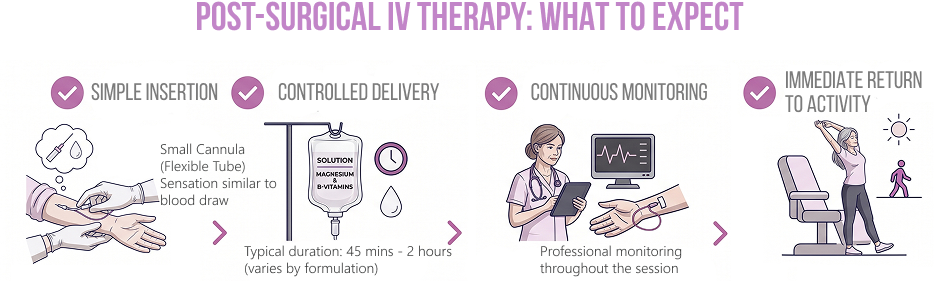
A small cannula – a thin, flexible tube – is inserted into a vein in the arm or hand. The sensation is similar to a routine blood draw. The infusion is then delivered at a controlled rate through a drip bag. Depending on the formulation, sessions typically last between 45 minutes and two hours.
You’ll be monitored throughout. Most patients find the experience calm and restful – many describe it as one of the more manageable parts of their recovery. No recovery time is required afterward. Normal activities can typically be resumed immediately.
Sessions can begin as soon as you are medically stable post-operatively – often within days of surgery, or after hospital discharge for outpatient infusions.
Is Post-Surgical IV Therapy Safe?
Yes – when administered by qualified clinicians in an appropriately equipped clinical setting. The risks are low and well-managed in reputable environments.
Safety considerations to be aware of:
- Allergic reactions are possible but uncommon. A reputable provider will monitor you throughout the infusion and maintain protocols to respond to any reaction promptly.
- Vein irritation can occur with repeated infusions at the same site but is generally minor and temporary.
- Nutrient imbalance or toxicity is a risk when IV therapy is administered without blood monitoring — particularly with fat-soluble nutrients that can accumulate. This is a strong reason to ensure your therapy is guided by clinical assessment and actual blood results, not offered as a generic wellness package.
 A clear red flag: any provider offering post-surgical IV therapy without reviewing your medical history, surgical details, and recent blood results is not meeting the standard of care this treatment requires. Choose providers who ask the right questions before connecting a drip.
Questions to Ask Your Surgeon or Care Team
Getting the most from post-surgical IV therapy starts with the right conversations before discharge.
- Is IV nutritional support part of my post-operative care plan — and if not, should it be?
- Which nutrients am I most likely to be depleted in given my specific surgery?
- When would it be clinically appropriate to start outpatient IV therapy after discharge?
- Should I have a blood panel done before starting IV therapy to identify specific deficiencies?
- Can you recommend a clinician or facility with experience in post-surgical IV nutrition?
A Final Word
The body does extraordinary work in the weeks after surgery. But it can only work with what it has. When fluids, vitamins, and key nutrients are in short supply, recovery becomes slower, harder, and more uncomfortable than it needs to be.
IV therapy doesn’t replace rest, physiotherapy, or proper post-surgical care. What it does is ensure the body has the raw materials it needs to do its job – delivered directly and completely, without relying on a digestive system that is often least capable of helping at the very moment it’s needed most.
If your recovery feels harder than it should, or if your care team hasn’t discussed nutritional support with you, it’s worth raising the question. For many patients, it makes a significant and measurable difference.
Book your first session at InVita Wellness, SoHo NYC
contact InVita Wellness today
Book Now
456 Broadway 2 Floor, New York, NY 10013, USA
Frequently Asked Questions
How soon after surgery can I have IV therapy?
As soon as you are medically stable — often within 48 to 72 hours of surgery, or shortly after hospital discharge. Your surgical team should advise on the appropriate timing for your specific procedure.
Is post-surgical IV therapy different from hospital drips?
Hospital IV drips primarily focus on hydration and medication delivery. Post-surgical IV therapy formulations used in recovery settings are more nutritionally targeted — combining vitamins, minerals, antioxidants, and amino acids specifically to support the healing process.
Will my insurance cover post-surgical IV therapy?
Coverage varies significantly. IV therapy administered as part of in-hospital care is typically covered. Outpatient IV therapy may be partially covered where there is a documented clinical indication — such as confirmed deficiency or inability to tolerate oral nutrition. Check your policy and request a clinical referral where possible to support any claim.
How many sessions will I need?
This depends entirely on the type of surgery, your pre-operative nutritional status, and how your recovery progresses. Some patients benefit from a single session; others incorporate IV therapy into a structured two to four week recovery programme. Blood testing helps determine what’s needed and when it can be reduced.
Can I have IV therapy if I’m taking prescription medications post-surgery?
Potentially yes, but this requires review by the clinician administering your IV therapy. Some IV formulations can interact with medications. Always disclose your full medication list — including any prescribed by your surgical team — before receiving any infusion.
This article is for informational purposes only and does not constitute medical advice. Always consult your surgeon, GP, or specialist before making changes to your post-operative care plan.
Dr. Leon Shapiro
Medical Director & Protocol Specialist
Medically reviewed by Dr. Leon Shapiro, MD, Harvard-trained anesthesiologist with 25+ years in clinical and research settings. Supervises InVita's IV protocols with expertise in integrative cardiovascular and metabolic wellness.
Resources
Weimann A, Braga M, Carli F, et al. ESPEN practical guideline: Clinical nutrition in surgery. Clinical Nutrition. 2021;40(7):4745-4761.
[DOI] doi.org
Arribas-López E, Zand N, Ojo O, Snowden MJ, Kochhar T. The Effect of Amino Acids on Wound Healing: A Systematic Review and Meta-Analysis on Arginine and Glutamine. Nutrients. 2021;13(8):2498.
[PubMed] pubmed.ncbi.nlm.nih.gov
Bezu L, Akçal Öksüz D, Bell M, et al. Perioperative Immunosuppressive Factors during Cancer Surgery: An Updated Review. Cancers. 2024;16(13):2304.
[PMC] ncbi.nlm.nih.gov
Gan TJ, Belani KG, Bergese S, et al. Fourth Consensus Guidelines for the Management of Postoperative Nausea and Vomiting. Anesthesia & Analgesia. 2020;131(2):411-448.
[PubMed] pubmed.ncbi.nlm.nih.gov
Hung K-C, Chu C-C, Hsing C-H, et al. Influence of Intravenous Magnesium Sulfate Infusion on the Subjective Postoperative Quality of Recovery: A Meta-Analysis of Randomized Controlled Trials. Healthcare (Basel). 2024;12(14):1438.
[PubMed] pubmed.ncbi.nlm.nih.gov
Molenaar CJL, Minnella EM, Coca-Martinez M, et al. The impact of prehabilitation on outcomes in frail and high-risk patients undergoing major abdominal surgery: A systematic review and meta-analysis. Clinical Nutrition. 2024;43(3):629-648.
[PubMed] pubmed.ncbi.nlm.nih.gov