Reviewed by the InVita Wellness Clinical Team InVita Wellness, SoHo, New York City
Quick Answer
- The appointment: 30 to 60 minutes for most drips, up to about 90 with certain add-ons.
- Hydration: your body processes infused fluid over the following hours. How long you notice relief depends on your starting hydration level, ongoing fluid intake, and activity.
- Nutrients and perceived effects: different ingredients are processed differently. Their time in the bloodstream does not establish how long you will feel a benefit, and cosmetic changes cannot be predicted from a single infusion.
On frequency: at InVita, a Good Faith Evaluation (GFE) is required for clearance before IV therapy. Blood work or other testing is not required beforehand. Follow-up timing depends on your wellness goals, the formula, and your response.
Medical Disclaimer
This article is educational and is not medical advice, diagnosis, or treatment. Nutrient infusions carry real cautions, including in kidney disease, heart failure, iron overload, and G6PD deficiency. At InVita, a Good Faith Evaluation (GFE) is required for clearance before IV therapy. Blood work or other testing is not required beforehand.
If you have had one drip and are wondering whether it is worth coming back, the answer depends on three things: what was in the bag, what you are hoping it supports, and how you responded to it.
At InVita, IV services support wellness, vitality, and recovery. A Good Faith Evaluation (GFE) is required for clearance before an infusion, and blood work or other testing is not required beforehand.
This guide covers elective wellness infusions, including hydration, vitamin, antioxidant, and NAD+ services. Session length and scheduling considerations vary by formula. It is not about IV fluids given in a hospital for a medical indication, which is a different situation entirely.
How long does an IV drip take?
Most wellness infusions run 30 to 60 minutes. A few formulas and add-ons take longer, up to about 90 minutes. Push injections, where a small volume is given slowly by syringe rather than by bag, take a few minutes.
Infusion speed is selected for the formula, the dose, and your individual tolerance. Some ingredients require slower administration, and your clinician may adjust the rate during the session.
Add 15 to 20 minutes to your calendar for intake, a blood pressure check, and placement. First visits take longer because the Good Faith Evaluation and the formula discussion happen then.
How long does IV therapy last?
There is no single duration that applies to every formula or every person. The more useful distinction is between how your body processes what was infused and how long you notice an effect. Those are different measures, and the first does not predict the second.
What is happening
What that does and does not tell you
Fluid and electrolytes
Your body redistributes and eliminates infused fluid over time. If you arrive dehydrated, fluid replacement may help relieve symptoms related to dehydration. The response varies, and this does not provide a precise countdown for symptom relief.
Water-soluble vitamins
The intravenous route reaches plasma concentrations that oral intake cannot. Time in the bloodstream is a measure of processing, not of how long you will feel a benefit.
Perceived and cosmetic effects
Different ingredients have different biological roles. Those roles alone do not establish that an infusion changes hair, skin, energy, or recovery, and cosmetic changes cannot be predicted from a single session.
Hydration
If you arrive dehydrated, fluid replacement may help relieve symptoms related to dehydration. The response varies, and an infusion should not be presented as a predictable treatment for fine lines or skin appearance.
Your body redistributes and eliminates infused fluid over time (Hahn, Frontiers in Physiology, 2024). That process does not provide a precise countdown for symptom relief. Ongoing hydration, activity, and the cause of the dehydration all influence how you feel afterward.
If dehydration is the main thing you are addressing rather than a side issue, a dedicated hydration infusion is usually the more direct option than an aesthetic formula.
Vitamin C and glutathione
Vitamin C is required for collagen biosynthesis, which is established biochemistry rather than a cosmetic claim (NIH Office of Dietary Supplements). The route genuinely matters for dose: oral intake, even at very large doses, raises plasma vitamin C to a maximum of about 220 micromoles per liter, whereas intravenous administration can reach concentrations as high as 26,000 micromoles per liter.
What that does not establish is a cosmetic outcome. A higher plasma concentration is not the same as a measured change in skin appearance.
IN SIMPLE TERMS
The IV route lets a far higher dose reach your bloodstream than a pill can. That part is settled. Whether the higher dose produces a visible change in how you look is a separate question, and the evidence for it is not there. Those are two different claims.
Glutathione has a well-described role in cellular redox balance and antioxidant defense, which is why it appears in wellness formulas. Its reputation as a skin-brightening infusion is a separate question. Evidence for IV glutathione as a skin-lightening treatment is limited and does not establish reliable, lasting results. Available studies have important limitations, and safety concerns remain. Findings from oral or topical glutathione cannot be assumed to apply to IV administration.
InVita offers glutathione formulas, including Skin Perfection and a dedicated IV glutathione service. More on glutathione’s biology is in our glutathione overview.
Biotin, amino acids, and NAD+
These ingredients have different biological roles. Those roles alone do not establish that repeated infusions improve hair, skin, energy, or recovery, or determine an appropriate schedule.
Biotin is a cofactor in normal metabolism, and deficiency does cause hair and nail problems. For people who are not deficient, the NIH Office of Dietary Supplements states that there is little scientific evidence to support the hair, skin, and nail claims made for biotin supplements, with only a few small studies in people with thin and brittle nails.
Amino acids are substrate rather than stimulus. Collagen is unusually rich in proline and lysine, and the vitamin C dependent enzymes that stabilize the collagen triple helix act on those residues, which is why the two are formulated together. Supplying substrate supports normal synthesis; it does not drive synthesis above normal. Our amino acid IV therapy overview goes into the detail.
NAD+ plays an essential role in cellular energy metabolism. Research on NAD+ precursors, which are taken orally, should be distinguished from research on NAD+ infusions. Evidence specific to IV NAD+ remains limited, and improvements in energy, focus, or recovery should not be guaranteed. See our NAD+ IV therapy guide for what a session involves.
What
These Ingredients Actually Do
What the evidence does and does not support
Understanding the evidence helps set realistic expectations before choosing a formula or a schedule.
IV delivery achieves plasma nutrient levels oral dosing cannot
Established. Documented for vitamin C: about 220 micromoles per liter oral ceiling versus up to 26,000 intravenously.
Fluid replacement may relieve symptoms related to dehydration
Reasonable where dehydration is present. The response varies and it is not a predictable treatment for skin appearance.
Vitamin C is required for collagen formation
Established biochemistry. Not the same as a demonstrated cosmetic result from an infusion.
IV glutathione lightens or brightens skin
Limited, and it does not establish reliable or lasting results. Available studies have important limitations and safety concerns remain. Oral and topical findings do not transfer to IV.
Biotin improves hair and nails in people who are not deficient
Not supported. NIH describes little scientific evidence for these claims.
IV NAD+ produces measurable functional benefit
Limited. Evidence on oral NAD+ precursors is a separate body of research and should not be read as evidence for infusions.
A fixed schedule of infusions suits everyone
Not established. No controlled trial has compared infusion frequencies for wellness or aesthetic endpoints.
The strength of evidence varies by ingredient and by intended use. The consultation should address suitability, expected benefits, limitations, and whether follow-up sessions are appropriate.
How often should you get IV therapy?
No controlled trial has compared infusion intervals for wellness or aesthetic endpoints, so any frequency presented as clinically established is overstated. At InVita, GFE clearance comes first, and the schedule after that is built around your goals, the formula, and how you respond.
Starting out: understand your response
The questions worth answering early are practical ones. How do you feel during the infusion? That evening? The next day? Did anything you came in for shift, and did you notice anything you did not expect?
After GFE clearance, follow-up sessions can be considered around your wellness goals, the formula, and your response. Discuss what you noticed and any side effects with the team so the plan can be adjusted.
Follow-up: reassess before repeating
Some clients return periodically; others use IV services occasionally. There is no universal maintenance interval. Follow-up should reflect your needs and your response rather than an automatic schedule.
Before travel or an event
If you are considering an infusion before travel or an event, discuss timing with the team. Allow time for assessment and for possible infusion-site bruising or other reactions.
Avoid trying a new formula immediately before an important occasion.
Scheduling considerations by formula
Different formulas raise different considerations. These are points to discuss, not schedules to follow.
Formula type
What that does and does not tell you
Your wellness goals, the ingredients, and your response. No universal cosmetic schedule is established.
Fluid intake, travel, activity, and suitability for the formula.
Individualize use. No established wellness interval applies to everyone.
Dose, administration rate, tolerability, and response. No validated universal loading or maintenance schedule exists. Any follow-up plan should be individualized and reassessed.
Training demands, recovery goals, and response.
All formulas require Good Faith Evaluation clearance before an IV. Blood work or other testing is not required beforehand.
Cautions and reactions
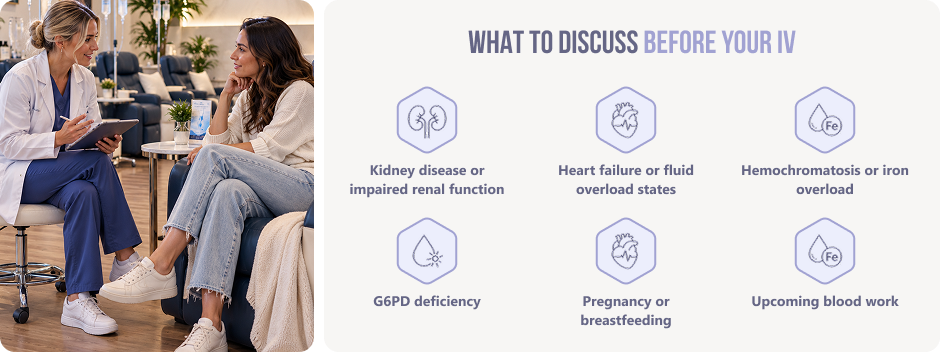
IV nutrient therapy carries risks related to the ingredients, the dose, the fluid volume, and intravenous administration itself. GFE clearance is required before IV therapy at InVita. These are the situations worth raising during that evaluation.
- Kidney disease or impaired renal function. Fluid and solute handling is the issue, and high vitamin C intake can raise urinary oxalate excretion, which is a particular concern in renal disorders.
- Heart failure or fluid overload states. Volume loading is inherent to an infusion and is the problem in these conditions.
- Hemochromatosis or iron overload. High doses of vitamin C can worsen iron overload and damage tissue.
- G6PD deficiency. High dose vitamin C is avoided because of hemolysis risk.
- Pregnancy or breastfeeding. Discuss with your obstetric clinician first. An elective nutrient infusion is not a default.
- Upcoming blood work. This one catches people out and is covered below.
SEEK HELP FOR A REACTION
Tell staff immediately if symptoms develop during an infusion. For severe symptoms after leaving, including difficulty breathing, chest pain, throat swelling, or fainting, call 911. Contact the clinic promptly for worsening pain, redness, or swelling at the IV site.
THE BIOTIN AND BLOOD TEST PROBLEM
Biotin above recommended amounts can cause
false results in some lab tests, including those measuring hormones such as thyroid hormone. Beauty and hair formulas often contain substantial biotin. If you have thyroid, hormone, or cardiac marker testing scheduled with your own doctor, tell both the InVita team and the lab that you are receiving biotin, and ask how long to leave between a drip and the draw.
Daily habits between sessions
Daily habits remain important between sessions.
- Daily water intake. Hydration is a daily requirement. An infusion cannot bank it for you.
- Daily broad spectrum SPF. Ultraviolet exposure is a major driver of oxidative stress in skin.
- Sulfur rich and antioxidant rich food. Cruciferous vegetables, alliums such as garlic and onion, avocado, and leafy greens support normal glutathione synthesis.
- Protein adequacy. Amino acid substrate comes mostly from your diet.
- Sleep and stress management. Both support overall wellbeing and should be considered alongside hydration, nutrition, and physical activity.

1
Daily Hydration
Drink water regularly; an infusion can’t replace daily hydration.

2
Daily Broad-Spectrum SPF
Helps protect skin from UV-related oxidative stress.

3
Antioxidant & Sulfur-Rich Foods
Greens, cruciferous vegetables, alliums, and avocado support glutathione synthesis

4
Adequate Protein
Your diet provides essential amino acids.

5
Sleep & Stress Management
Support overall wellbeing alongside nutrition, hydration, and activity
Frequently Asked Questions
How long does an IV drip take?
Most wellness infusions take 30 to 60 minutes, and some formulas or add-ons take up to about 90 minutes. Add roughly 15 to 20 minutes for intake, vital signs, and placement, and allow longer for a first visit, when the Good Faith Evaluation takes place.
How long does IV therapy last in your body?
Your body redistributes and eliminates infused fluid over time, and water-soluble vitamins are processed and cleared. How your body processes an infusion and how long you notice an effect are different measures, and the first does not predict the second.
How long do the effects of IV therapy last?
There is no single duration that applies to every formula or client. Nutrient processing and perceived effects are different measures. The ingredients, your starting hydration level, and ongoing nutrition, hydration, and activity all matter.
How often can you get IV therapy?
There is no universal interval. At InVita, GFE clearance is required before an IV, and blood work or other testing is not required beforehand. Follow-up should reflect your wellness goals, the formula, and your response rather than an automatic schedule.
How often should you get IV therapy for skin and hair?
No universal cosmetic schedule is established, and cosmetic changes cannot be predicted from a single infusion. Consider your wellness goals, the ingredients in the formula, and how you responded, and discuss follow-up with the team.
How often should you do NAD+ IV therapy?
No validated universal loading or maintenance schedule exists. Considerations include dose, administration rate, tolerability, and response. Any follow-up plan should be individualized and reassessed rather than set in advance.
Does IV therapy brighten skin?
Evidence for IV glutathione as a skin-lightening treatment is limited and does not establish reliable, lasting results. Available studies have important limitations, and safety concerns remain. Findings from oral or topical glutathione cannot be assumed to apply to IV administration.
Is more frequent IV therapy better?
Not necessarily. More frequent treatment does not automatically provide greater benefit and may increase ingredient exposure and risk. Frequency should be reviewed for the specific formula and your circumstances.
Do I need blood work before IV therapy at InVita?
No. A Good Faith Evaluation is required for clearance before IV therapy, and blood work or other testing is not required beforehand. Your schedule should reflect your wellness goals, the formula, and your response.
Can I get an IV drip the day before blood tests?
Tell the team and your lab first. Biotin above recommended amounts can cause false results in some tests, including thyroid and other hormone assays, and beauty formulas often contain substantial biotin. Ask how long to leave between a drip and the draw.
How much does IV therapy cost at InVita?
Pricing varies by formula and by whether add-ons are included. Current per-drip pricing is listed on the IV vitamin therapy menu, and the team can walk you through it before you book.
Start with a conversation
Start with a conversation about your wellness goals, your routine, and the experience you are looking for. The team can explain the available formulas, what a visit involves, and the Good Faith Evaluation clearance required before an IV. Blood work or other testing is not required beforehand.
Start with a conversation
contact InVita Wellness today
Book Now
InVita Wellness, SoHo, New York City. Serving Manhattan, Brooklyn, and the surrounding metropolitan area.
References
- National Institutes of Health, Office of Dietary Supplements. Vitamin C: Fact Sheet for Health Professionals.
ods.od.nih.gov/factsheets/VitaminC-HealthProfessional
- National Institutes of Health, Office of Dietary Supplements. Vitamin C: Fact Sheet for Consumers.
ods.od.nih.gov/factsheets/VitaminC-Consumer
- National Institutes of Health, Office of Dietary Supplements. Biotin: Fact Sheet for Consumers.
ods.od.nih.gov/factsheets/Biotin-Consumer
- Hahn RG. Sequential recruitment of body fluid spaces for increasing volumes of crystalloid fluid. Frontiers in Physiology. 2024;15:1439035.
doi:10.3389/fphys.2024.1439035
- Zubair S, Hafeez S, Mujtaba G. Efficacy of intravenous glutathione vs. placebo for skin tone lightening. Journal of Pakistan Association of Dermatologists. 2017;26(3):177-181.
doi:10.66344/jpad.v26i3.18
- Sonthalia S, Daulatabad D, Sarkar R. Glutathione as a skin whitening agent: facts, myths, evidence and controversies. Indian Journal of Dermatology, Venereology and Leprology. 2016;82(3):262-272.
doi:10.4103/0378-6323.179088
- Khatri S, Abdellatif M, Sedej S. Clinical evidence for the use of NAD+ precursors to slow aging. Geromedicine. 2025;1:202508.
doi:10.70401/Geromedicine.2025.0008